
ONE. Moving Toward a New Era of Sustainable Development
In recent years, multiple challenges, including global climate change, social inequality, and volatility in capital markets, have profoundly reshaped the corporate operating environment and the logic of investment evaluation. As international initiatives such as the “Paris Agreement” and the United Nations Sustainable Development Goals (SDGs) gain momentum, sustainability has evolved beyond an extension of corporate social responsibility (CSR) to become a core issue in global economic governance. In this trend, ESG (Environmental, Social, and Governance) is regarded as a key framework for measuring a company’s long-term value and sustainable competitiveness. Investors no longer focus solely on financial returns, they increasingly value corporate performance in areas such as climate risk management, stakeholder rights, information transparency, and governance structures. Companies that effectively address ESG issues not only gain market trust but also attract long-term capital inflows in financial markets, thereby enhancing their overall competitiveness.
Since the Financial Supervisory Commission (FSC) issued the “Blueprint for Strengthening Corporate Governance in Taiwan” in 2013, it has continuously promoted a series of regulatory reforms aimed at improving corporate governance quality and building a sound capital market. The establishment and implementation of the “Corporate Governance Evaluation” system has been playing a key role in policy promotion. Since its launch in 2014, it has served as an important driver for guiding corporate self-discipline and improvement, enhancing transparency in information disclosure, and strengthening board operations and shareholder rights protection.
However, as environmental and social issues gain increasing international attention, focusing solely on corporate governance can no longer fully reflect a company’s overall sustainability. Business risks have expanded beyond governance deficiencies to encompass environmental impacts and social responsibility dimensions. Therefore, to cultivate sustainable value within the market, ensure comprehensive assessment of TWSE/TPEx listed companies' sustainable development performance across various ESG dimensions, and equip investors with reliable references for ESG investment decisions, the FSC has issued the “Sustainable Development Action Plans for TWSE- and TPEx-Listed Companies (2023). The plan designates “promoting ESG evaluation” as a key measure, aiming to help companies identify sustainable risks and opportunities through the fine-tuning of the evaluation framework and refinement of indicators. This deepens internal sustainability governance culture, implements risk management and information transparency, together with guiding investors to adopt an ESG perspective for responsible investing. Fostering a sustainable capital cycle, responding proactively to international sustainability trends, advances the international integration of Taiwan’s capital markets.
TWO. Process of Transition from the Corporate Governance Evaluation to an ESG Evaluation
I. Corporate Governance Policy Promotion and Progress
The assessed enterprises for Corporate Governance Evaluations are all listed companies, and the evaluation happens annually. The analysis scope encompasses the full calendar year from January 1 to December 31. To ensure transparency and objectivity, the evaluation is primarily based on publicly disclosed information, including corporate governance-related data published during the evaluation year on the Market Observation Post System, annual reports, sustainability reports, and company websites. The relevant significant achievements or instances of non-compliance with corporate governance principles are also considered. Upon final assessment, all the collected dta is submitted to the Evaluation and Advisory Committee. The results are announced by the end of April in the following year.
For over a decade, Corporate Governance Evaluations have consistently served as a vital catalyst for policy evolution and implementation. To more effectively promote the adoption of key initiatives outlined in the blueprint for TWSE/TPEx listed companies, the FSC advocates that companies voluntarily implement corporate governance best practices that go beyond the legal requirements by incorporating them into the evaluation indicators first. The adoption of effective practices among TWSE/TPEx-listed companies provides a benchmark for the transition from the voluntary into mandatory regulations.
An example of this can been seen in the promotion of shareholder activism through electronic voting. It was after the introduction of this as a key indicator in the 2014 evaluation that adoption surged from 13.50% to 71.41% by 2017. This is especially noteworthy as this increase represents more than a four-fold jump. Having achieved such successful implementation, the FSC mandated electronic voting for all listed companies in 2018, and this indicator has since been removed as the objective had been achieved.
Many other key corporate governance initiatives have also been yielded positive results to date. These include:
- Improved oversight by the appointment of independent directors, audit committees, and corporate governance officers;
- Board transparency with the promotion of a candidate nomination system for board elections;
- Gender diversity in ensuring at least one director of each gender serves on the board;
- Term limits in that no independent directors can serve more than three consecutive terms; this applies to over half of them.
These measures are now being gradually incorporated into the regulations, making compliance mandatory for all TWSE/TPEx-listed companies.
II. Promotion and Expansion of Sustainable Development
As the impacts of global climate change become increasingly imminent, the international community has begun to focus on corporate sustainability, which is gradually emerging as a core global value. After rolling out a series of corporate governance blueprints, the FSC further advanced to the “Sustainable Development Roadmap for TWSE- and TPEx-Listed Companies” in 2022, with the goal to help TWSE/TPEx listed companies respond to the impacts of climate change and to establish carbon reduction targets at an early stage. This led to the “Sustainable Development Action Plans for TWSE- and TPEx-Listed Companies” being released in 2023.
Active implementation of sustainable development by enterprises is continuously promoted, thereby enhancing their international competitiveness. This is achieved through a strategy founded on four key pillars—governance, transparency, digitalization, and innovation—and five major dimensions: leading enterprises toward net-zero, deepening corporate sustainability governance culture, refining sustainability information disclosure, strengthening stakeholder communication, and advancing ESG evaluation and digitalization
Among these, “advancing ESG evaluation”—as one of the five major dimensions of the said action plan—represents a key direction for the FSC in establishing a culture of sustainable value within the capital markets. In fact, since the first Corporate Governance Evaluation in 2014, it has served to guide TWSE/TPEx listed companies in implementing sustainable development practices amid the advancing global sustainability trend. The “Protection of Stakeholder Interests and Corporate Social Responsibility” dimension (now changed to the “Promotion of Sustainable Development” dimension) already encompasses a wide range of ESG-related indicators, including promoting the establishment of dedicated or concurrent units for sustainable development or ethical management, the disclosure of greenhouse gas emissions, the formulation of related reduction policies, employee welfare measures, and retirement systems, and disclosures on working conditions as well as measures to safeguard employee personal safety. By actively drawing on global sustainability practices and adhering to the FSC’s corporate governance blueprints and action plans, the ESG evaluation criteria will be progressively enhanced.
TWSE/TPEx listed companies are encouraged to proactively adopt ESG measures exceeding the legal requirements, thereby establishing a culture of sustainable corporate operations. The goal is that the public will continue to pay greater attention to sustainability issues, in order to build a shared understanding of this core value within the capital markets.
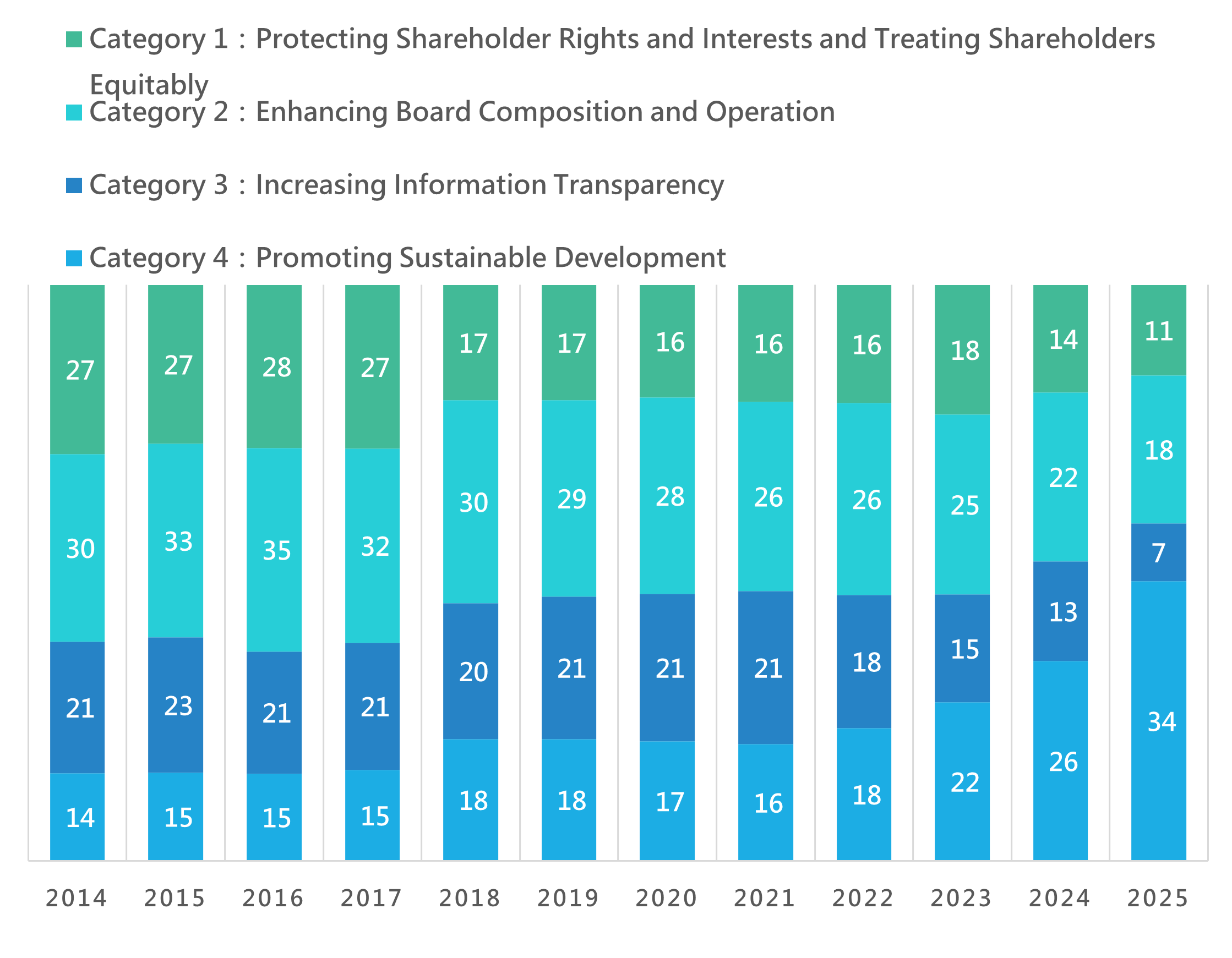
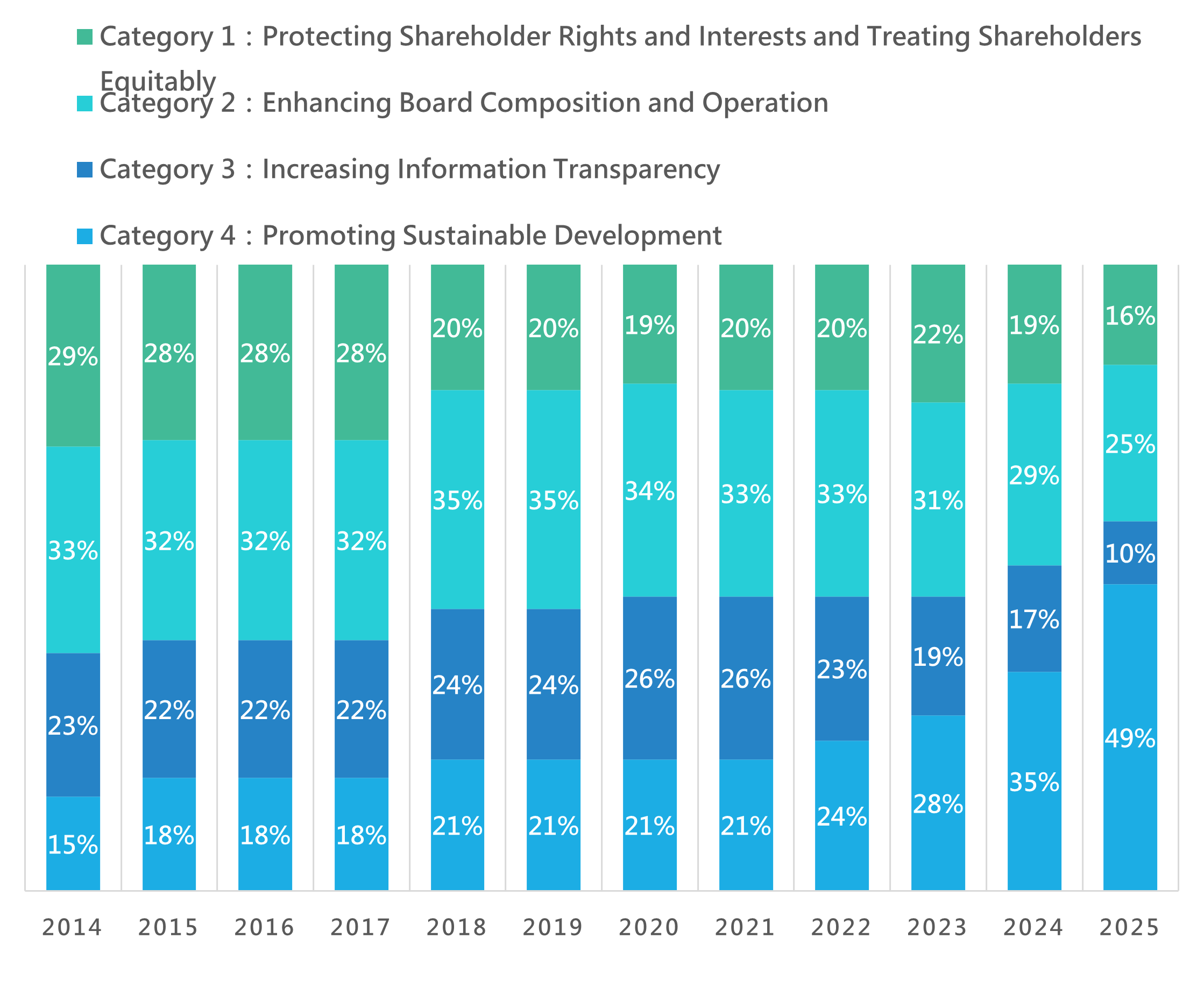
Statistics on the number of indicators and weighted scores across the four major dimensions of Corporate Governance Evaluations (as shown in Figures 1 and 2 below) reveal that from the first evaluation (2014) to the tenth (2023), the dimension with the highest number of indicators and weighted scores was “Strengthening Board Structure and Operations.” The primary reason lies in the fact that the board of directors serves as the most crucial foundation for corporate operations and development. The evaluation has always been aligned with policies such as the FSC’s Corporate Governance Blueprint, striving to solidify the foundation of TWSE/TPEx listed companies, enhance the functions and accountability of their boards, and cultivate sound corporate governance practices from the ground up. Additionally, the figure below reveals another significant trend: the number of indicators and weighted scores within the “Promotion of Sustainable Development” dimension have steadily increased over the past decade. Starting from the twelfth evaluation (2024), it has become the dimension with the highest proportion, accounting for 49% of both indicators and weighted scores. The Corporate Governance Evaluation progressively evolves alongside worldwide standards and policies. By adjusting the indicators and their weighting, it advocates that TWSE/TPEx listed companies bring global sustainability benchmarks into their corporate values and practices.
III. Evolutional Transition of ESG Evaluation Indicators
Further indicator analysis of the “Promotion of Sustainable Development” dimension in the Corporate Governance Evaluation shows that, over the years, international sustainable development practices and domestic policy advances have been progressively referenced, resulting in the addition of numerous key topics across the Environmental (E), Social (S), and Governance (G) aspects. However, the overall evaluation still places a higher weighting on Governance (G) indicators. There remains room for further expansion of indicators related to the environmental and social dimensions. Accordingly, to achieve the vision of promoting ESG evaluation as outlined in the FSC’s 2023 “Sustainable Development Action Plans for TWSE- and TPEx-Listed Companies,” starting from the eleventh Corporate Governance Evaluation (for the 2024 fiscal year), in addition to routinely referencing international trends in corporate governance and sustainable development, the relevant regulations, policies, and feedback from all sectors to refine existing indicators, the indicators related to environmental and social dimensions are progressively expanded each year. The number and weighting of indicators across the three ESG dimensions are adjusted incrementally.
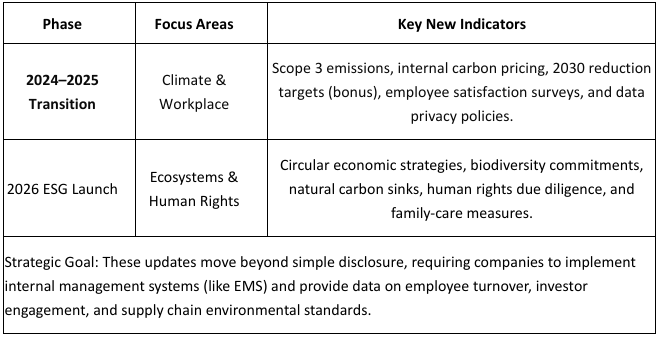
To achieve a balanced weighting across ESG dimensions, the 11th (2024) and 12th (2025) Corporate Governance Evaluations have incrementally increased the focus on Environmental (E) and Social (S) indicators. This shift encourages companies to formalize their ESG systems and improve data transparency through the following measures:
Environmental Enhancements: To prioritize climate action, indicators for greenhouse gas (GHG) emissions and reduction policies have been expanded. New metrics include Scope 3 emissions disclosure, the establishment of Environmental Management Systems (EMS), and internal carbon pricing.
Examples of these include: the indicators “disclosing annual greenhouse gas emissions for the past two years” and “establishing greenhouse gas reduction management policies” have been separated from the original indicator. A new indicator, “disclosing Scope 3 greenhouse gas categories and annual emissions for the past year,” has been added – along with “establishing an Environmental Management System,” “developing an energy management plan,” and “implementing internal carbon pricing.” Notably, setting 2030 carbon reduction targets is now recognized as an advanced bonus criterion.
Social Enhancements: New indicators focus on employee growth and consumer protection. These include mandates for employee training programs, satisfaction surveys, and the implementation of Personal Data Protection Policies to safeguard customer rights. In terms of specific examples, the new indicators having been added are: “Establishing employee training and development plans to enhance employees’ career capabilities” and “Conducting regular employee satisfaction surveys.” Customer privacy protection is one of the highest regulatory goals and to that end, “Establishing a Personal Data Protection Policy” and “Establishing Policies and Complaint Procedures for Protecting Consumer or Customer Rights,” are new indicators.
Thereafter, upon formally transitioning to the first ESG evaluation (2026), additional indicators will be established to further strengthen and implement practices addressing various environmental and social issues. This aims to drive companies to enhance management capabilities and ensure effective execution, including:
From an environmental perspective, to encourage companies to adopt corresponding management actions on various environmental issues, enhance energy efficiency, and pay attention to biodiversity and ecological conservation, in addition to separating “disclosing total waste weight” and “environmental requirements in supplier management policies” from the original indicators, new indicators have been added, such as “formulating policies to promote the circular economy or waste management,” “disclosing energy usage status,” “establish biodiversity policies or commitments,” and “formulating strategies and measures to promote natural carbon sinks.”
From a societal perspective, to deepen companies’ commitment to safeguarding human rights and employee welfare, strengthen proactive communication with investors, and promote support for innovative startups, new indicators have been added, such as “establishing human rights due diligence investigations,” “providing marriage-friendly and family-care measures,” “disclosing employee turnover rates and reasons for departure by gender and age,” “disclosing investor engagement activities,” and “disclosing investments in domestic innovative startups.” Additionally, “employer contributions exceeding the legal requirements under the new pension system” has been designated as an advanced bonus criterion.
To align corporate performance with global ESG standards, the evaluation framework is transitioning from "Corporate Governance" (2024–2025) to a comprehensive "ESG Evaluation" (2026).
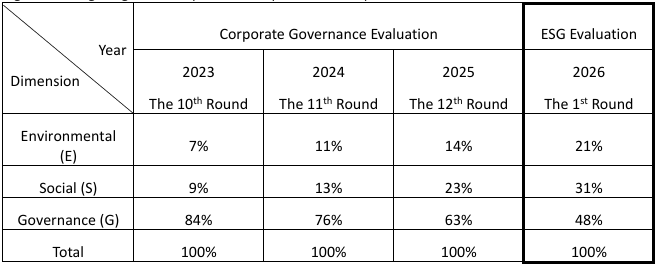
Following adjustments to the evaluation indicators over nearly three consecutive sessions, regarding the weighting of ESG indicators across the three aspects (as shown in Figure 3 below), the weightings for indicators in the environmental and social aspects have increased from 7% and 9% in the tenth evaluation to 21% and 31%, respectively. Meanwhile, the weighting for governance aspects has decreased from 84% to 48%. This demonstrates that the weightings across the three ESG aspects are gradually becoming more balanced.
THREE. Current Status and Prospects of the Transformed ESG Evaluation
I. Framework and Indicator Content of the Transformed ESG Evaluation
In summary, following the refined expansion of the environmental and social dimensions within the “Corporate Governance Evaluation” – it was renamed the “ESG Evaluation” in October 2025. The original four dimensions were restructured into three key dimensions: “Environmental (E),” “Social (S),” and “Governance (G),” with respective weightings of 21%, 31%, and 48%. The main content is categorized and integrated as follows
- Environmental (E) Indicators
Environmental (E) indicators primarily encompass topics such as greenhouse gases, water resources, waste, energy management, climate change impacts, ecological impacts, and environmental management within the supply chain. In addition to focusing on establishing comprehensive environmental sustainability systems, including management policies and measures for greenhouse gases, water consumption, and waste or promotion of the circular economy, energy management plans, climate change risk and response measures, internal carbon pricing implementation, environmental management systems, biodiversity policies or commitments, promotion of natural carbon sink strategies and measures, and environmental management policies for suppliers. Additionally, focus is placed on the disclosure and application of environmental data, including greenhouse gas emissions, water consumption, total waste weight, and energy usage. Moreover, contributions to sustainable development are encouraged, including the issuance or investment in sustainable development bonds. This aims to guide TWSE/TPEx listed companies in prioritizing environmental issues, thereby reducing impacts on the natural environment, biodiversity, and humanity, and ultimately achieving net-zero and environmental sustainability goals.
- Social (S) Indicators
Social (S) indicators primarily encompass topics such as human rights and community relations, stakeholder communication, business ethics and regulatory compliance, business model resilience, cybersecurity and customer privacy, customer rights, social supply chain management, labor treatment and welfare, employee health and safety, employee loyalty, and diversity and inclusion. In addition to establishing and implementing measures focused on protecting stakeholder rights and promoting communication and interaction, such as human rights policies and due diligence investigation, support for community and domestic cultural development, stakeholder identification and communication, investor engagement and disclosure of question-and-answer situations, cybersecurity risk management, personal data protection policies, consumer or client rights protection policies and complaint procedures, and supplier social management policies, it also guides companies to prioritize operational ethics and resilience, which includes promoting the establishment of ethical management departments, formulating policies and implementing internal and external whistleblowing systems, managing intellectual property, and supporting innovative startups. Moreover, companies’ efforts to safeguard and implement employee rights and benefits are being actively strengthened, which includes employee compensation, benefits, retirement systems, health and safety protections, career development programs, opinion surveys and improvements, workplace diversity and gender equality initiatives, marriage- and childbirth-friendly or family-supportive work environments, and resignation circumstances and reasons. The goal is to drive TWSE/TPEx listed companies toward fulfilling their social responsibilities, ensuring that safeguarding human rights and labor welfare becomes a central pillar of their sustainable growth.
- Governance (G) Indicators
Governance (G) primarily encompasses topics such as safeguarding shareholder rights and treating shareholders equitably, strengthening board structure and operations, enhancing information transparency, and promoting sustainable development. In terms of safeguarding shareholder rights and treating shareholders equally, this includes formulating and disclosing corporate value enhancement plans, as well as implementing mechanisms for submitting individual director compensation proposals to shareholders’ meetings. Regarding the soundness and operation of the board structure, this includes board diversity policies and measures, promotion of gender diversity among directors, and the establishment and execution of various functional committees. In enhancing information transparency, this encompasses the voluntary disclosure of individual director and executive compensation, as well as conducting institutional investor briefings. Additionally, in promoting sustainable development, this includes establishing and operating a sustainable governance framework, formulating policies linking ESG performance to senior executive compensation and their effectiveness. The objective is to strengthen the cornerstone of sustainable operations by encouraging TWSE/TPEx listed companies to implement governance mechanisms, ultimately fostering a proactive culture of corporate sustainability.
II. Future Vision and Outlook for the ESG Evaluation
As global and domestic standards for corporate governance and sustainable development mature, the evaluation framework has undergone a decade of evolution. What began as a focus on foundational board structures and information transparency has transformed into a comprehensive assessment of sustainable development. Today, the framework prioritizes shareholder and stakeholder engagement, resilience in the face of environmental change, and the initiative-taking fulfillment of social responsibilities.
Looking forward, the ESG Evaluation (transitioning in 2026) will remain agile, monitoring international sustainability trends and integrating domestic policy objectives into its criteria. By continuously refining these indicators, the evaluation aims to inspire TWSE/TPEx listed companies to move beyond compliance. The ultimate goal is to establish sustainability transformation that aligns domestic enterprises with the highest international benchmarks for sustainable management.
FOUR. Conclusion
The ESG Evaluation serves a dual purpose: it enables investors to identify high-potential, sustainable companies, and it acts as a benchmark for enterprises to assess their own ESG performance. This makes it so that companies can leverage these insights to fuel their strategies and transition toward sustainability.
Through transparent and impartial evaluation mechanisms, companies can bolster their global competitiveness and align with international standards. Concurrently, this framework empowers capital markets to direct investment toward firms that demonstrate genuine long-term value and transition resilience. Ultimately, the ESG Evaluation is a game-changer on the road of ESG evolution by fostering a collective consensus of growth, it establishes a solid foundation for sustainable development and the enduring strength of our capital markets.