In recent years, fraud has become one of the most pressing hidden threats to social and financial stability in Taiwan.
Scam cases have continued to evolve in scale and sophistication, causing substantial financial losses to the public while undermining confidence in financial transactions.
Recognizing the seriousness of the issue, the government has continued to strengthen its anti-fraud framework. As early as 2004, the National Police Agency, Ministry of the Interior, launched the 165 Anti-Fraud Hotline to provide consultation and reporting services. To further enhance transparency in combating fraud, the Criminal Investigation Bureau introduced the “165 Anti-Fraud Dashboard” in August 2024, publishing fraud statistics and real-life case examples to raise public awareness. Taking that month as an example, losses from fake investment scams alone reached NT$8.909 billion, accounting for more than 64% of total fraud-related financial losses.
In parallel, the government has rolled out the “Next-Generation anti-fraud strategy guidelines” in multiple phases since June 2022, May 2023, and November 2024, together with the enactment of four pieces of anti-fraud legislation (the Fraud Crime Hazard Prevention Act, along with amendments to the Communication Security and Surveillance Act, Money Laundering Control Act, and Code of Criminal Procedure). These efforts reflect a comprehensive policy approach aimed at reducing the social costs of fraud through prevention, detection, enforcement, and public education.
From Fraud Awareness to Fraud Prevention: TWSE’s Three-Stage Public Education Strategy
With regards to all types of fraud, financial investment scams have consistently ranked among the highest in terms of monetary losses. As Taiwan’s core platform for capital raising and securities trading, the Taiwan Stock Exchange has long been committed to investor education and anti-fraud awareness.
In addition to producing educational materials, the TWSE has in recent years adopted emerging AI technologies to strengthen source-level detection. By developing AI-powered automated monitoring modules, the TWSE has enhanced the timeliness of identifying and reporting suspicious fraudulent advertisements.
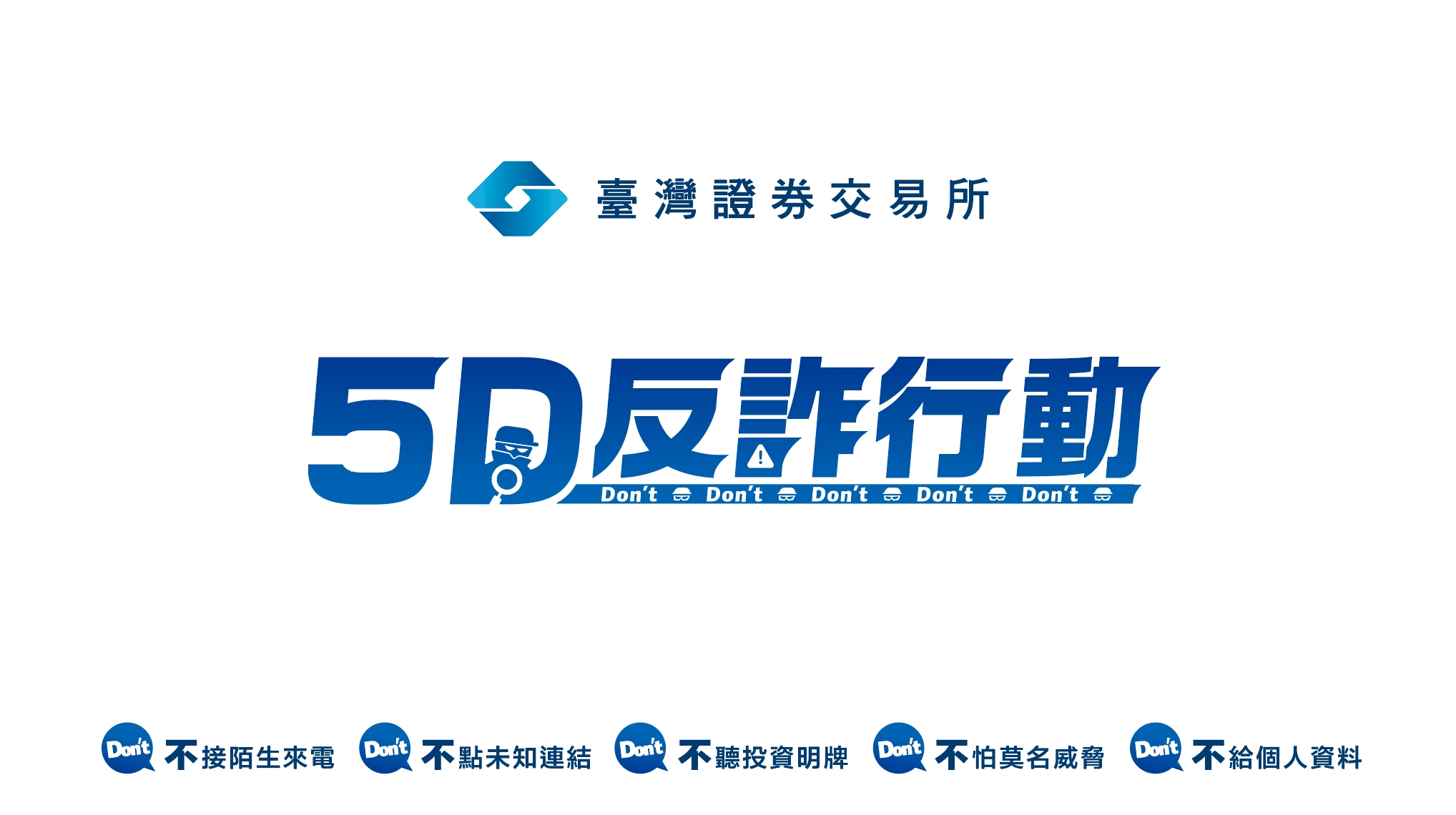
At a time when losses from investment scams were particularly severe, the TWSE launched an integrated public awareness initiative in the fourth quarter of 2024: the “5D Anti-Fraud Campaign.” Centered on the “Five Don’ts” principle — don’t answer unknown calls, don’t click unknown links, don’t listen to investment “hot tips”, don’t be afraid of threats, and don’t give out personal information — the campaign encourages the public to think carefully before making investment decisions.
To make anti-fraud messages easier to remember and act upon, the campaign moved beyond traditional warning-based communication. Instead, it adopted a three-tiered strategy combining culture, entertainment, and education, with the aim of deepening public awareness and turning fraud prevention into an intuitive daily habit. Within just 18 months, the campaign had generated more than 236 million impressions, reached and attracted approximately 50 million views along with engagements, and recorded nearly 480,000 clicks.
Phase One: “Give Your Money the Time of a Song” (Q4 2024 – February 2025)
The first campaign focused on building a memorable psychological first line of defense through music and creative communication.
The TWSE observed that karaoke culture is deeply rooted in everyday life in Taiwan. To quickly embed anti-fraud awareness in the public mind, the first phase adapted the well-known 1990s Taiwanese pop song Love’s Liar, I Ask You into an anti-fraud and catchy version titled Money-Loving Scammer. The key message was simple: when money is involved, pause and think before taking action.
The creative mechanism retained the familiar melody while rewriting the lyrics to include common fraud tactics and scam scripts. Through humor, familiarity, and repeated exposure, the campaign goal was aimed to help people recall the melody when facing suspicious messages, thereby creating an instinctive mental break before they respond, click, transfer funds, or provide personal information.
To expand its reach, The TWSE released the music video and advertisements in October 2024, followed by the “5D Anti-Fraud Dance Challenge” in following months. Listed companies, securities firms, accounting firms, key opinion leaders, and the public were invited to participate. By combining music with movement, the campaign strengthened memory retention and extended its reach to more participants through multiple digital channels.
The TWSE also brought anti-fraud messages into everyday settings. Campaign slogans such as “Give your money the time of a supermarket trip,” “the time of a coffee break,” or “the time of a workout” were promoted in supermarkets, cafés, gyms, and food delivery platforms. This allowed the public to encounter anti-fraud reminders not only on social media, but also in daily consumption scenarios.
Another highlight was the co-branded Anti-Fraud Limited Edition “Kuai Kuai” snack packaging. By printing anti-fraud tips on a familiar national snack, The TWSE brought fraud prevention messages into securities firm branches across Taiwan and, through delivery platforms, directly into households.
Phase Two: “Beware of the Ghosts Behind the Scam” (March – December 2025)
Building on the public response to the first phase, the second phase shifted from broad awareness to a deeper understanding of scam tactics.
With the slogan “A deceitful mouth, a deceitful ghost.” The TWSE reminded the public to beware of “ghosts” hidden behind suspicious investment messages. The strategy was to make abstract scam types more concrete, visual, and memorable.
Base on cases collected through the “Anti-Fraud Joint Defense Section” platform, The TWSE invited six illustrators — Steven Tung, Lau Kwong Shing, Kim Chen, Croter Hong, Raimochi, and Tonn Hsu — to create visual characters. These “Six Fraud Ghosts” including the Identity Ghost, the Data Ghost, the Speculative Ghost, the Advisor Ghost, the LINE Group Ghost, and the Impersonation Ghost, each represented a common investment scam pattern. By turning fraud tactics into vivid characters with distinct visual styles, The TWSE transformed complex fraud typologies into concepts that were easier for the public to recognize and discuss.
The TWSE also launched the “Financial Investment Fraud Ghost Stories” website, bringing the six fraud ghosts into storylines and case-based scenarios. Interactive campaigns such as the “Which Fraud Ghost Is Targeting You?” personality quiz and the “Financial Fraud Ghost Stories” competitions encouraged people to share their own experiences and learn from others. In doing so, serious anti-fraud messages were converted into engaging digital experiences.
To maintain long-term exposure, The TWSE also worked with KOLs such as HowHow(@howhowhasfriends), @87acup, and @specsome2022, as well as the parenting community platform Mamibuy. Through short videos and sponsored articles, the campaign reached more specific audience groups together with continuing to accumulate public engagement in a steady and sustained manner.
Phase Three: “Freeze! Check First!” (Starting April 2026)
After the two phases helped build fraud awareness and improve recognition of scam patterns, the third phase focused on encouraging concrete anti-fraud action.
The TWSE launched an upgraded version of the “Securities Anti-Fraud Joint Defense Section” platform, designed to make verification easier and more accessible for the public. The core message of this phase was “Freeze! Check First!” — a playful phrase combining Mandarin, Taiwanese, and English pronunciation to remind people to stop, stay calm, and verify before taking action.
In April 2026, The TWSE released two dramatized advertisements inspired by police action films and traditional Taiwanese drama. Through unexpected plot twists, the ads strengthened the public’s memory of anti-fraud messages. They were broadcast across television, social media platforms, convenience stores, bus advertisements, and Taiwan Taxi in-car video systems, creating a multi-channel visual reminder in everyday life.
The upgraded online platform emphasized three features: easy to find, easy to understand, and easy to listen to. The classification of fraud types was expanded from 14 to 18 categories, and complex announcement tables were redesigned into a visual dashboard. This allowed the public to verify scam patterns more quickly.
The TWSE also launched the “Anti-Fraud Number Puzzle Challenge,” moving beyond one-way education and encouraging active participation. Password clues were released across different news platforms and securities firm platforms, guiding the public to visit the anti-fraud website and complete verification tasks. The goal was to turn anti-fraud knowledge into actual checking behavior.
Looking Ahead: Building a Sustainable Anti-Fraud Ecosystem
With the continuing efforts of the government and relevant institutions, monthly fraud-related financial losses have fallen below NT$5 billion since February 2026, while losses from fake investment scams declined to less than NT$2 billion in April. These figures show that anti-fraud efforts are beginning to show results. Nevertheless, building society-wide fraud awareness and further reducing financial losses remain long-term challenges.
TWSE’s anti-fraud strategy is not limited to short-term creative campaigns. Looking ahead, The TWSE will continue to strengthen anti-fraud measures in the securities market, including AI-based monitoring of suspicious advertisements, continuous updates to the “Securities Anti-Fraud Joint Defense Section” platform, and enhanced anti-fraud training for securities industry professionals.
TWSE’s long-term goal is to reinforce the resilience of Taiwan’s capital market by combining digital tools, daily-life communication channels, and cross-sector collaboration. By connecting the government, securities firms, market participants, and the public, the TWSE aims to build a sustainable anti-fraud ecosystem — one where fraud awareness leaves no blind spots, and investor protection is always within reach.
Through the “5D Anti-Fraud Campaign,” the TWSE will continue to safeguard the assets of Taiwan’s investors, strengthen public trust, and contribute to the stability and resilience of Taiwan’s capital market.