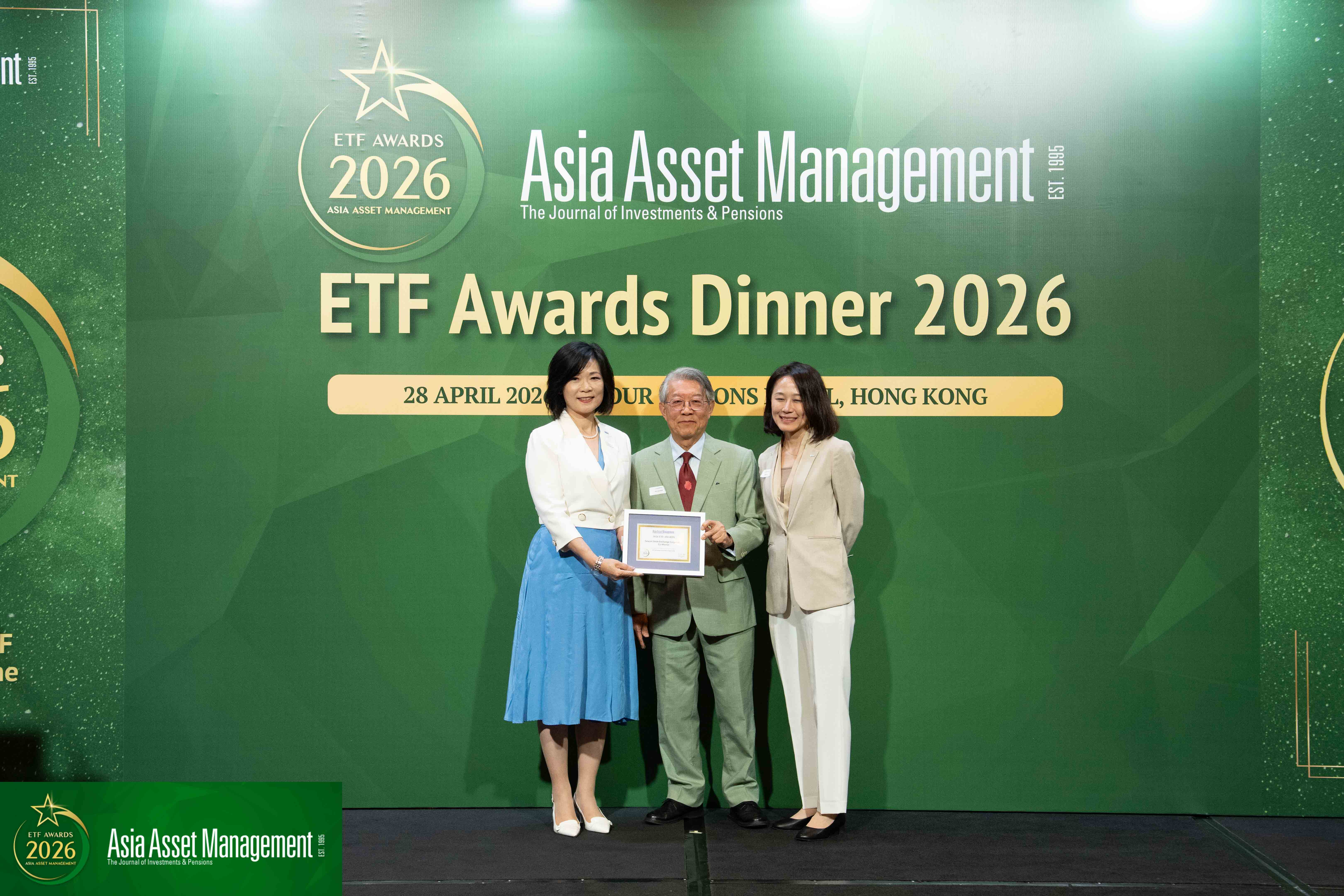
The award ceremony for the 2026 Asia Asset Management ETF Awards, organized by the internationally renowned Asia Asset Management (AAM) magazine, was held on April 28, 2026. The Taiwan Stock Exchange (TWSE) was honored with the "ETF Exchange of the Year in Asia-Pacific" award. This recognition highlights TWSE's outstanding contributions to the market, including promoting ETF market efficiency, cross-border cooperation, investor education, and the growth of ETF assets under management (AUM).
Despite the fierce competition in the Asia-Pacific ETF market, Taiwan's ETF market performance has stood out. In 2024, TWSE collaborated with regulatory authorities, peripheral organizations, and industry players to conduct joint studies. Consequently, the Financial Supervisory Commission (FSC) officially announced the liberalization of active ETFs and passive multi-asset ETFs at the end of that year, which injected a new wave of investment momentum into the Taiwanese ETF market in 2025. Since the first active ETF was launched on TWSE in May 2025, a total of 23 active ETFs have been listed as of the end of April 2026, with total AUM exceeding NT$520 billion. This rapid growth has set an excellent example of cooperation among participants in the Taiwan ETF ecosystem to facilitate the launch of innovative ETF products. Attracted by the "Asia Asset Management Center" initiative and the liberalization of diversified products, four global asset management companies also chose to join Taiwan’s ETF market in 2025.
To meet investor demands and enhance the depth and breadth of the ETF market, TWSE has been closely monitoring rapid global trends alongside the liberalization of active ETFs and passive multi-asset ETFs, and has begun researching new strategies for the diversification of next-generation ETF products. By analyzing international trends, outsourcing research, and collecting feedback from industry players, TWSE keeps pace with the development dynamics of various new ETF products globally, such as multi-asset ETFs, target-maturity ETFs, options-based ETFs (such as covered call ETFs and buffer ETFs), cryptocurrency ETFs, and single-stock leveraged/inverse ETFs.
Among these different types of ETFs, TWSE has identified several product categories that could serve as the direction for Taiwan's next stage of development. For instance, looking across various types of ETFs, there is a clear global trend toward utilizing a Fund of Funds (FoF) structure to build underlying assets, enabling cross-asset allocation through a single fund. More than 60% of multi-asset ETFs globally adopt this structure. Applying this concept to ETFs results in an "ETF of ETFs" structure. By using a basket of ETFs as the primary investment target, this structure lowers the trading and management costs associated with issuers holding a vast array of individual securities, thereby improving issuance efficiency and product portfolio diversity while providing investors with versatile asset allocation options.
In the global multi-asset ETF market, over 60% adopt active management, indicating that active multi-asset ETFs are gradually becoming mainstream allocation tools. In addition to breaking traditional asset classification boundaries, the application of active strategies enables managers to operate more flexibly and rapidly adjust asset allocation during market volatility—such as increasing holdings in defensive assets. This strengthens the portfolio's responsiveness and effectively improves overall investment efficiency.
Securities investment trust enterprises (SITEs) also expect to further expand the product scope by incorporating covered call strategies into the ETF framework. Covered call ETFs have experienced rapid growth internationally in recent years. By holding underlying stocks while continuously writing call options, these funds incorporate collected premiums into distributable income. Their primary appeal is providing higher yields than traditional dividend-paying ETFs, while generating additional returns and offsetting partial losses during market consolidation or downturns. Beyond Europe and the United States, markets in the Asia-Pacific region—including Japan, South Korea, Australia, and Hong Kong—have already liberalized covered call ETFs. With global AUM exceeding US$100 billion, they have become highly favored income-generating tools.
Participants in the Taiwan ETF ecosystem are jointly pursuing continuous product innovation to align with international trends and satisfy the diverse needs of investors. While receiving international award recognition, the Taiwan Stock Exchange continues to actively innovate and develop more diversified products. By implementing financial inclusion, TWSE aims to build a highly efficient ETF market, foster a robust ecosystem, and serve as a driving force in establishing Taiwan as an Asia Asset Management Center.