
Preface
Since 2017, securities firms in Taiwan have been permitted, pursuant to the Regulations Governing Securities Firms Trading in Securities on a Fixed-Term, Fixed-Amount Basis, to accept investors’ fixed-term, fixed-amount investments in securities such as stocks and exchange-traded funds (ETFs). This mechanism draws on the earlier practice of subscribing to mutual funds through fixed-term, fixed-amount plans, enabling investors to adopt an approach intended to average out holding costs and reduce volatility risk. In light of the policy planning of the competent authority overseeing the securities market at the time, the objectives of vigorously promoting this initiative were not only to encourage investors to adopt a long term capital allocation approach, invest in the stock market in a prudent and steady manner, and share in the growth dividends of high quality enterprises, but also to enable securities firms, when assisting clients with asset allocation, to simultaneously monitor clients’ cash flow movements. In addition, this approach may be used to develop a new small scale retail investor customer base, thereby helping to invigorate the stock market and expand the scope of securities firms’ operations.
According to the latest statistics released by the Taiwan Stock Exchange, as of the end of November 2025, the monthly investment amount under fixed-term fixed-amount plans reached NT$19.597 billion, exceeding the previous record of NT$19.464 billion set in October 2025 and marking a new all-time high. This represents an increase of approximately 24.55% compared with the investment amount recorded in December 2024. The market is broadly optimistic that, supported by the year end window dressing rally in December, there is a strong likelihood that the figure will challenge the NT$20 billion threshold. At the same time, the number of active trading accounts increased to 4.5002 million, the highest level since August 2024. This underscores that the fixed-term, fixed-amount investment strategy, which is particularly favored by younger investors, has not only met its implementation targets, but that the subsequent influence of this new cohort of market participants remains on a strong upward trajectory. As fixed-term, fixed-amount investing has gradually become a stable force underpinning the development of Taiwan’s equity market, one that cannot be overlooked, some securities firms have also begun to recognize the substantial business opportunities it represents. Building on the existing foundation of success, they hope to capitalize on current momentum and even incorporate fintech related linkages, with a view to further scaling up transaction volumes.
By way of illustration, consider the “Stock Gift Card (https://wwwc.twse.com.tw/market_insights/zh/detail/8a8216d697769dcf0197be75940400ef)” discussed in a feature article published by the Taiwan Stock Exchange. SinoPac Securities Co., Ltd. (hereinafter “SinoPac Securities”) drew on the experience of overseas securities markets, such as Korea, in promoting gift vouchers, and submitted an application to the Financial Supervisory Commission (FSC) to conduct a financial technology innovative experimentation. Through the online issuance of electronic gift vouchers combined with fixed-term, fixed-amount investing, the program guides customers to use gift vouchers received as gifts or purchased to redeem an equivalent amount of investable funds, which may then be used to invest in 242 eligible Taiwan listed stocks and ETFs available on the firm’s “Feng Cun Gu” platform. More recently, the company has partnered with convenience store operators to sell the stock gift cards in the form of Lunar New Year lucky bags, promoting an advertised maximum return of up to ten times the purchase value. This approach has not only stimulated demand for the gift cards, but has also opened a new chapter of cross-industry collaboration between securities firms and retail distribution and service providers.
Pilot Proposal Plan for Monetizing Everyday Life and Building a Regular, Prudent Investment Business Model
With the global surge of digitalization, virtual reward points and related incentive programs have become an important tool for business operations, promotional campaigns, and even the provision of employee benefits. Across industries such as mobile payments, retail, and e commerce platforms, it is now widely accepted for consumers to use previously earned reward points to offset part or all of their purchase costs. As the impact of the points economy continues to expand, the circulation of points has increasingly developed toward cross-industry and cross-channel use. Building on this, Cathay Securities Corporation (hereinafter “Cathay Securities”), which has long focused on the vast potential of first time stock market investors and is committed to streamlining rapid online account opening for small-scale retail investors, soon followed in the footsteps of SinoPac Securities Corporation. In June 2025, Cathay Securities applied to the FSC for approval to pilot an innovative service under the banner “Monetize Everyday Life, Invest Regularly and Steadily.” Its core concept is to integrate consumers’ accumulated reward points and guide them to convert those points into seed capital for fixed-term, fixed-amount investing, thereby maximizing the value of points by translating them into shareholdings accumulated in the account and gradually building long term wealth.
Pursuant to the Operational Directions for Financial Institutions Applying for Business Trials, a financial institution may apply to the FSC for a trial of a business item not yet permitted under an administrative rule, interpretive rule of the FSC, self-regulatory rule established by a financial industry association, or a rule of a self-regulatory organization (hereinafter referred to as a “business trial”). Once approved by the FSC, the business trial is exempt from the restrictions set out in the foregoing rules mentioned in the FSC approval letter during the trial period and within the scope of the trial.
The term “business items not yet allowed”, as referred to above, includes new business models and expansions of existing business models. Accordingly, Cathay Securities Corporation (hereinafter “Cathay Securities”) submitted a case-specific application to the FSC for approval to conduct a business trial of the service. Based on the contents of its business plan, the proposal primarily involves establishing a partnership with a non-financial company specializing in the operation of loyalty points, and enabling investors to use the points balance held under their accounts, namely Tree Points, through a conversion mechanism that converts the points balance into cash-equivalent funds, which are then integrated with the offset function for settlement payments in online fixed-term fixed-amount securities transactions. The application has since been approved, with the regulator recognizing it as an expansion of a securities firm’s previously approved business scope, and therefore falling within the definition of “business items not yet allowed” under Item 3, Subparagraph 3 of the aforementioned Operation Directions of Financial Institutions Applying for Business Trial.
Upon review, “Tree Points” are a group wide reward points program launched by the Cathay Group and named after its corporate brand icon. Known for connecting multiple platforms and enabling flexible use across affiliated companies, the program is generally categorized into two major types, namely Tree Points (Credit Card) and Tree Points (Lifestyle). The former may be earned through spending on various credit cards issued by Cathay United Bank. The latter are points issued by Symphox Information Co., Ltd. (hereinafter “Symphox Information”) While they do not require redemption through actual spending, users may obtain such Tree Points only by completing designated tasks in Cathay CUBE Rewards, or by participating in marketing or promotional campaigns organized by the group’s affiliated companies. Tree Points (Lifestyle) and Tree Points (Credit Card) may be combined for use. When Tree Points (Credit Card) are applied to offset payments for fixed-term, fixed-amount investments, they are first automatically converted into Tree Points (Lifestyle) and then used for the offset. Accordingly, the term “Tree Points” is used hereinafter as a collective reference to both types.
Flexible Conversion of Everyday Reward Points into Investable Assets
After the Securities and Futures Bureau (SFB) of the FSC convened a meeting with the Taiwan Stock Exchange Corporation (TWSE) and the Taipei Exchange (TPEx) for deliberation, and invited Cathay Securities’ project team to attend and provide an explanation, Cathay Securities subsequently submitted supplementary materials, including its internal control system, anti money laundering and counter terrorism financing measures, arrangements for advance collection and earmarking of funds, disclosure of key contract terms, and a compliance and risk management statement. The FSC then approved Cathay Securities’ proposed plan in August 2025. Cathay Securities accordingly commenced the pilot program on December 22, 2025, and, together with Symphox Information Co., Ltd., which belongs to the same LinYuan Group, jointly launched an innovative service that enables fixed-term, fixed-amount subscriptions using points, breaking from traditional securities investment models and offering an alternative financial experience to the capital market.
By doing so, once a customer has executed the Rules for Converting Tree Points into Cash to Offset Fixed-Term, Fixed-Amount Investments, together with the Statement on Personal Data Transfer and Declaration of Intent, the customer may use any Tree Points accumulated through everyday activities to offset the investment amount for fixed-term, fixed-amount investments in Taiwan listed stocks via the Cathay Securities App. The current offset rate is set at 1:1, meaning one point is equivalent to NT$1. With a minimum of only 100 points, customers can subscribe to and invest in stocks and ETFs. This not only materially lowers the investment threshold, but, by integrating digital finance with consumers’ day-to-day spending habits, also encourages small-scale retail investors to adopt a flexible and relatively light-burden investment approach to build up their financial asset base over time, and to turn small, steady increments into a long-range plan that allows a sapling to grow into a forest of wealth.

Establishing a Dedicated Zone to Distinguish It from Cash-Based Fixed-Term, Fixed-Amount Subscriptions
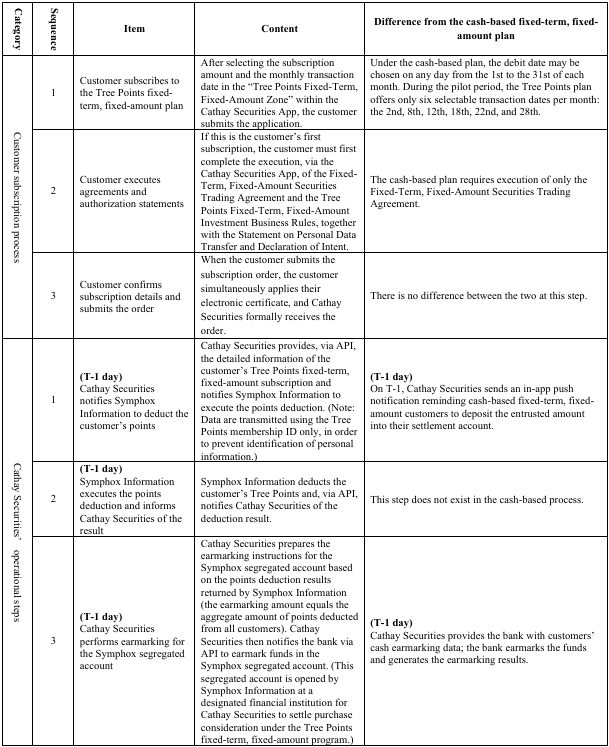
To prevent confusion among first time users during the initial rollout, Cathay Securities established a dedicated “Tree Points Fixed-Term, Fixed-Amount” zone for the pilot program, so as to clearly differentiate it from the existing fixed-term, fixed-amount zone funded by cash. In the initial phase, the service imposes restrictions on subscription amounts and debit dates. The scope of availability will be reviewed and adjusted based on outcomes after the pilot is completed. All other operational rules are handled in accordance with the firm’s existing Fixed-Term, Fixed-Amount Securities Trading Agreement.
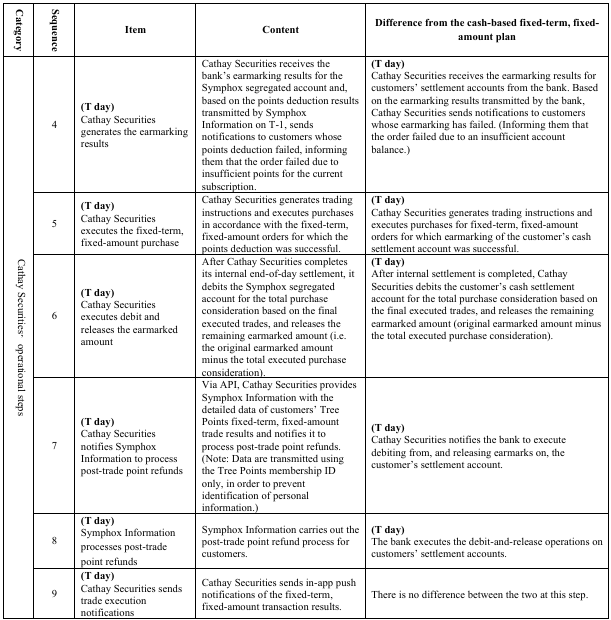
According to the disclosures shown in the pilot zone, the customer must first consent to authorize a third party, namely Symphox Information, to process the deduction of the agreed amount of Tree Points from the customer’s points balance on T-1 (the business day preceding the scheduled purchase date), and to apply the cash equivalent in advance as an offset against the settlement amount payable for the transaction. Thereafter, Symphox Information will remit the cash equivalent of the redeemed points to a designated segregated account opened at a financial institution specified by Cathay Securities Corporation, and the funds will be earmarked for exclusive use in settling purchases under the Tree Points fixed-term fixed-amount program, as follows:
- Eligible securities: In line with Cathay Securities’ existing fixed-term fixed-amount eligible universe. Eligible targets include 99 stocks and 155 ETFs, which may be added or removed from time to time in accordance with the firm’s criteria.
- Transaction dates: The 2nd, 8th, 12th, 18th, 22nd, and 28th of each month, providing six debit date options.
- Amount: In increments of NT$100, with a minimum of NT$100 and a maximum of NT$3,000. One point offsets NT$1. The subscription amount includes both the transaction consideration and transaction handling fees.
- Restrictions: Fully segregated from the standard fixed-term fixed-amount program. Only a full points to cash conversion method is accepted to offset both the transaction consideration and transaction handling fees. Mixed payment (part points and part cash) is not accepted. If the points balance is insufficient for a given debit, the customer may not top up the shortfall with cash.
- Fees: The same as Cathay Securities’ current fixed-term fixed-amount handling fee, charged as a flat NT$1 (that is, one point) per order.
Evaluation of Pilot Benefits and Consumer Rights Protection
Cathay Securities Corporation’s approved business trial expansion item, “Monetize Everyday Life, Invest Regularly and Steadily,” is subject to a six-month pilot period and is restricted to the pilot zone within the company’s dedicated App. A preliminary assessment indicates that Symphox Information’s existing Tree Points membership base already totals approximately 2.2 million members, with 0.8 million active members. Accordingly, the potential beneficiary segment of this pilot is by no means negligible. Taking the Tree Points issued by Symphox Information in 2024 as an example, the total exceeded 1 billion points, averaging approximately 1,250 points per member. As the points balance continues to increase year by year, a conservative estimate suggests that at least 100 points per month could be used for fixed-term, fixed-amount investing. Viewed in this light, if the pilot can be rolled out successfully, it is expected to deliver multiple benefits for investors and the broader financial ecosystem, including higher market participation, improved convenience and applicability of the points economy, innovative investment approaches, and enhanced market competitiveness.
With respect to the protection of financial consumers’ rights and interests, during the business trial period, the company shall follow the current operational procedures governing fixed-term, fixed-amount investing in Taiwan listed equities and shall implement the service in strict accordance with the Fixed-Term, Fixed-Amount Securities Trading Agreement executed by both parties. The company shall execute purchases in accordance with the conditions and purchase dates specified by the customer in the agreement, purchase the agreed eligible securities using the cash equivalent of the customer’s redeemed points, and, upon execution, credit the securities to the customer’s securities custody account. After a fixed-term, fixed-amount standing order is established, any request to terminate or amend the subscription details will take effect on the next business day following submission of the request through the platform, which is consistent with the current fixed-term, fixed-amount operating process. If an order cannot be executed due to force majeure factors, such as the eligible security being subject to trading disposition measures or being locked at the daily limit-up price on the trading day, the full amount of points will be refunded. Unless the company has obtained the customer’s sufficient and explicit authorization in advance, it may not transfer the customer’s data to any partner or to any points issuing company.
The success of the business trial will be assessed against specific criteria, including the number of subscription orders, total subscription amount, the number of complaints, and data protection performance. Specifically, the total number of subscription orders submitted under the trial shall be no fewer than 1,000, the total subscription amount shall be no less than NT$500,000, the number of complaints must be zero, and the number of personal data leakage incidents must be zero. Regardless of whether the above targets are met, the company shall submit to the competent authority for record an inspection report and an overall business trial implementation report compiled and prepared by its internal audit department in conjunction with relevant personnel from information technology, legal and regulatory compliance, and risk management. If the business trial fails or upon expiry of the trial period, the existing Tree Points fixed-term, fixed-amount standing orders will automatically terminate. The company will notify customers by email and via push notification through its dedicated securities App five trading days prior to termination. If a customer still has fixed-term, fixed-amount investment needs, the customer may switch, based on actual needs, to the standard fixed-term, fixed-amount subscription plan settled in cash.

“Make Your Points Count, Earn Rewards While Building Your Portfolio” Promotional Campaign
To ensure that the business pilot achieves its target performance and to boost investor participation and public attention, Cathay Securities filed and implemented the “Make Your Points Count, Earn Rewards While Building Your Portfolio” promotional campaign for the period from January 1, 2026 to February 28, 2026, in accordance with the Taiwan Securities Association Rules Governing Advertising, Business Solicitation, and Business Promotional Activities by Members. During the two month campaign period stated above, any participant who completes at least one Tree Points fixed-term, fixed-amount subscription and whose points deduction is successful will receive one entry into the lucky draw. Eligibility will be determined based on the subscription date.
After the campaign ends, Cathay Securities will conduct a public draw to select 30 winners, and each winner will receive 3,000 Tree Points as the prize. Eligibility is subject to restrictions. Participants must be domestic natural persons who hold a Cathay Securities account and have a National Identification Card number. The campaign expressly excludes customers whose place of birth is outside Taiwan, who have foreign tax residency, who hold corporate accounts, who are in default, who hold Cathay Securities internal staff accounts (code 98), or who have previously closed their accounts.
In addition to actively promoting the Tree Points fixed-term, fixed-amount subscription service to new customers, Cathay Securities also launched an enhanced reward program for existing customers. Eligibility is limited to customers who, between October 1, 2025 and December 31, 2025, completed at least three regular fixed-term, fixed-amount subscriptions with successful debits. Customers meeting the above criteria will receive a bonus of 100 Tree Points if, between January 1 and February 28, 2026, they complete at least one Tree Points fixed-term, fixed-amount subscription and the points deduction is successful. This bonus is not awarded through a draw, but it is limited to 1,500 recipients. If the number of eligible subscriptions completed on the same subscription date exceeds 1,500, rewards will be granted in order of application submission time.
Offsetting Insurance Premiums with Points: Cathay Life Has a Prior Precedent
In fact, using Tree Points to offset amounts receivable from customers by group affiliates was not the first attempt by the LinYuan Group. As early as July 2024, Cathay Century Insurance Co., Ltd. (hereinafter “Cathay Century Insurance”) partnered with Symphox Information to apply for a pilot program for a Tree Points premium offset service, marking the first case in Taiwan’s financial sector to integrate, on a cross-industry basis, financial lifestyle services with a rewards-points ecosystem. After receiving approval from the FSC, the pilot program was launched in October 2024. Over a six-month pilot period, the total number of policies purchased using points reached 1,727, far exceeding the initial target of 600. Cumulative points used also approached 900,000, representing notably strong performance.
Building on the above, to enhance the convenience of online insurance purchases and service applications for consumers, while also promoting fintech development and the digital transformation of the insurance industry, the FSC announced amendments in April 2025 to the Directions for Insurance Enterprises Engaging in Electronic Commerce Business. In addition to relaxing requirements regarding the application methods for group insurance policyholders, travel-related insurance products, and channels for online sales of critical illness insurance, the amendments also revised the rules on identity verification mechanisms for online insurance services and on sampling telephone interviews used to confirm applicants’ intent. Furthermore, the amendments allow a policy applicant to use vouchers or the applicant’s own membership points to offset part of the insurance premium. In other words, to facilitate insurers’ applications for business pilot items of this nature, the FSC added, under Point 15, Subparagraph 1 of the above Directions, additional premium payment methods. In addition to the previously prescribed methods, namely payment by the applicant’s own credit card, deposit account, or a Class I or Class II electronic payment account, vouchers or membership points may also be used for partial premium offsets. The cross-industry collaboration between Cathay Century Insurance and Symphox Information for the Tree Points premium offset service officially went live on April 16, 2025.
To ensure that insurance premiums are collected in full, the amendments also added Point 15, Subparagraph 3, which requires insurers and voucher or points operators to establish verification mechanisms and enter into cooperation agreements. Such mechanisms may include binding the points operator’s membership account, verifying the membership ID associated with a voucher, or using other verifiable methods. As for the contractual terms between the parties, they should include, without limitation, the cooperating operator’s obligations for personal data protection, arrangements for handling financial difficulties, payment frequency, and payment assurance mechanisms, such as promissory notes, trust arrangements, or other measures sufficient to secure full remittance to the insurer of premium amounts offset through vouchers or points, thereby serving as an appropriate control framework.
Innovative Experimentation Plus Business Trials: Encouraging Innovative Financial Products and Services
To foster a regulatory environment conducive to fintech innovation, the FSC has, since 2018, implemented an innovative experimentation mechanism under the Financial Technology Development and Innovative Experimentation Act. To address concerns raised by academia – including a cumbersome review process, unclear review criteria and post experiment outcomes, the absence of a clear pathway for implementation, and potential conflicts in the regulator’s role – the competent authority further established in 2019 a business trial mechanism for three sectors, namely banking, securities and futures, and insurance. Through this dual track approach of innovative experimentation and business trials, a safe environment is provided for fintech research, development, and prototyping, while encouraging financial institutions and fintech startups to introduce innovative financial products and services to the market.
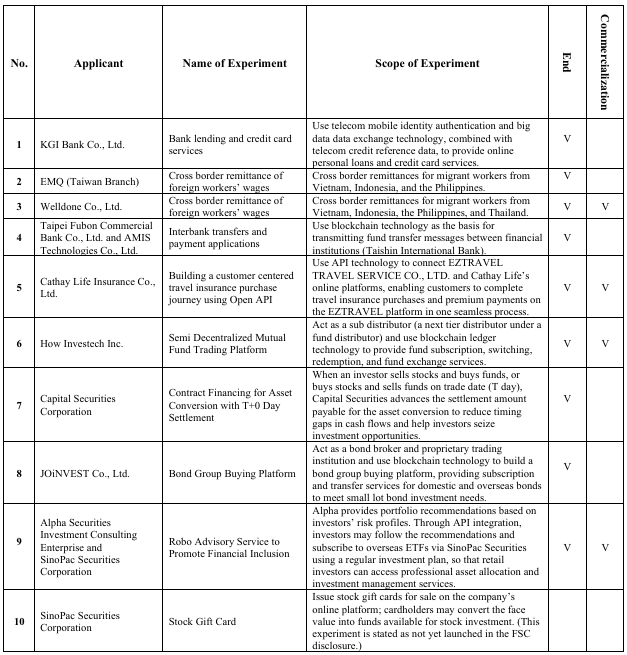
To broaden both the scope and intensity of financial innovation and to provide a consistent regulatory framework for financial institutions applying for business trials, the FSC, guided by the Five FinTech Development Strategies, promulgated the Operation Directions of Financial Institutions Applying for Business Trial in October 2024. The key revision focuses included expanding the scope of business trials, increasing the categories of financial institutions eligible to apply, encouraging collaboration between financial institutions and other businesses, promoting inclusive finance innovation, and adjusting the required application documentation.
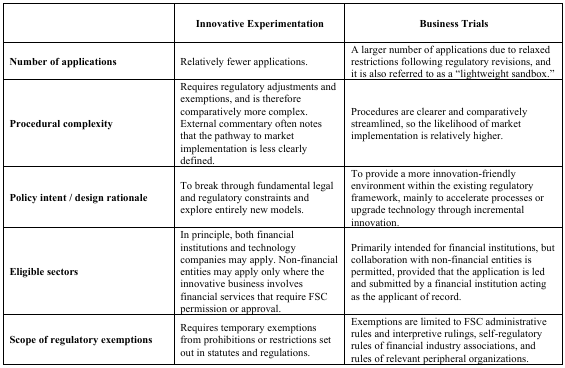
The above-mentioned cases involving SinoPac Securities’ stock gift card program and Cathay Securities’ Tree Points redemption for settlement payments are both related to the current periodic fixed-amount investment scheme. However, the legal bases underlying the two applications are fundamentally different. The former applied for a sandbox experiment under Article 4 of the Financial Technology Development and Innovative Experimentation Act and Article 2 of the Regulations Governing Financial Technology Innovative Experimentation. The latter, by contrast, proceeded under the subsequently introduced and comparatively more accessible Operation Directions of Financial Institutions Applying for Business Trial, which imposes fewer restrictions and more accommodating thresholds for conducting a business trial.
The regulatory sandbox (innovation experiment) and the business trial program are both mechanisms for financial innovation. The main differences lie in the level of regulatory involvement and the eligible applicants: the business trial program (now transitioned into a more flexible “lightweight sandbox”) primarily addresses issues at the level of the FSC’s internal administrative rules and interpretive guidance. Eligibility is limited to financial institutions, the procedures are relatively streamlined, and the purpose is to allow testing in areas that have not yet been explicitly opened under regulation but are not illegal. By contrast, the original regulatory sandbox (innovation experiment) may involve prohibitions or restrictions at the statutory level. Eligible applicants may include non-financial firms; regulatory exemptions are required, and the procedures are more complex, aiming to overcome legal barriers. At present, the FSC has further relaxed the business trial mechanism, adopting a lightweight sandbox approach that focuses primarily on innovation through collaboration between financial institutions and non-financial partners, while emphasizing procedural simplification to facilitate market implementation.
Supplement: Regulations on the Earning and Use of Reward Points
Pursuant to Paragraph 4 of Article 19 of the Regulations Governing Institutions Engaging in Credit Card Business, the reasons for which a card issuer may grant credit card bonus points, as well as the permitted scope of use of such points, must be handled in accordance with the requirements prescribed by the competent authority. In this regard, the Banking Bureau of the FSC issued Order No. 10240000210 on January 31, 2013, specifying that the permissible grounds for generating credit card bonus points are limited to the following categories: credit card marketing activities (for example, earning points through card spending), applying for credit card related services (for example, applying for e statements), prizes awarded through credit card promotional draws, participation in credit card related activities (for example, expressing appreciation for a cardholder’s suggestions regarding credit card services), and transfers from other cardholders.
As for the permitted uses of bonus points, the same Order provides that such points may be used only for: redeeming goods, offsetting the charged amount or purchase amount at the time of a transaction, offsetting fees for credit card value added services (for example, airport pickup services), offsetting revolving credit interest or related charges, offsetting service fees and interest relating to other banking services, redeeming mileage rewards, offsetting telecommunications charges, offsetting public utility bills or donation amounts, and transferring points to other cardholders.
In view of the above restrictive rules governing bonus points, the Securities and Futures Bureau (SFB) of the FSC previously required Cathay Securities, with respect to its Tree Points fixed term fixed amount investment pilot program, to provide a supplementary written explanation as to whether the program conflicts with any mandatory legal requirements described above. The purpose was to clarify the nature of the application and to inform the consideration of whether subsequent regulatory adjustments may be necessary. Upon review, Symphox Information Co., Ltd., the issuer of Tree Points (Lifestyle), is not a financial institution, and neither the Ministry of Finance nor the FSC serves as its competent authority. Accordingly, the regulatory restrictions described above are not readily applicable to Symphox Information. By contrast, Tree Points (Credit Card), provided by Cathay United Bank to its credit card customers, clearly fall within the scope of the above-mentioned restrictions governing credit card bonus points and, therefore, must comply with the rules on the grounds for point accrual and the permitted scope of use.
However, Tree Points (Credit Card) cannot be used directly to offset settlement payments for fixed-term, fixed-amount investments. Under Cathay Securities’ proposed arrangement, while the two categories of Tree Points may be used in combination, Tree Points (Credit Card) must first be converted into Tree Points (Lifestyle) before they can be used for any offset. Further, Tree Points (Lifestyle) issued by Symphox Information may, by nature, also be characterized as a digitized commodity. Therefore, converting Tree Points (Credit Card) into Tree Points (Lifestyle) should be regarded as redeeming goods with credit card bonus points, and does not appear to go beyond the reasonable scope of permitted use as set out in the foregoing regulations.