
In compliance with the policy of green finance and the international trend of sustainable development, the Taiwan Stock Exchange Corporation (hereinafter referred to as the TWSE) and the Financial Information Service Co., Ltd. (hereinafter referred to as the FISC) will collaborate to launch the digital service of “Financial Blockchain Bank Guarantees for Securities Borrowing” on December 30, 2024.
Bank guarantees play a crucial role for the guarantee of securities lending and borrowing by securities firms with a twofold purpose: firstly, when a securities borrower entrusts a securities firm to declare fixed or competitive price borrowing through the TWSE’s securities borrowing system, a bank guarantee may be used as the collateral; secondly, when a securities firm borrows securities from a customer, a bank guarantee may serve as the performance bond of 10% of the borrowing amount to be deposited with the TWSE.
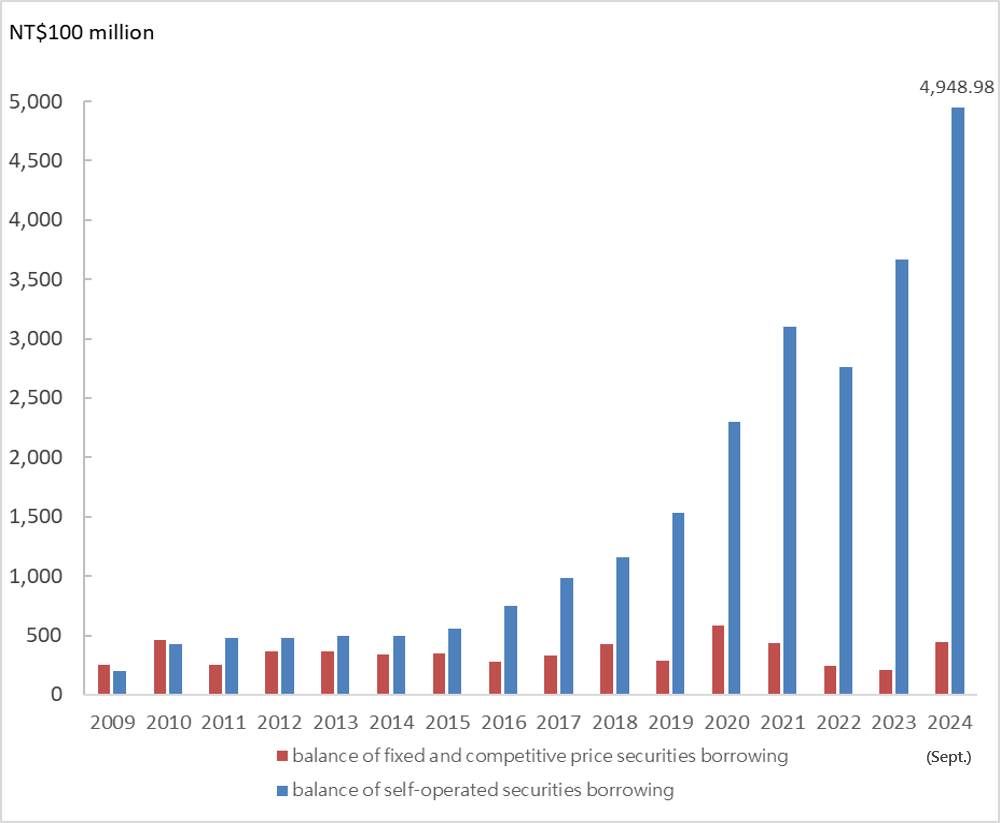
Although the balance of fixed and competitive price securities borrowing has remained at the same level in recent years, the growth rate of the balance of securities firm or securities finance enterprise conducting securities borrowing and lending business (hereinafter jointly referred to as self-operated securities borrowing) has been astonishing. As of the end of September this year, the self-operated securities borrowing balance reached NT$494.898 billion (as shown in the figure below), more than 8 times higher than the NT$60.671 billion when securities borrowing from customers was first opened to securities firms in February 2016, with an average annual growth rate of 30%. In the future, it is expected that the demand for bank guarantees will only increase but not decrease, and it is now a critical moment to introduce new technologies to improve the operational efficiency.
Responding to Digital Transformation to Eliminate Pain Points and Bring A New Era
The current bank guarantee deposit and withdrawal procedures for securities borrowing still require cumbersome paper-based operations. For a letter of guarantee issued, the securities firm needs to obtain the original copy from the bank, and then dispatch its personnel to the TWSE for processing, and when the letter of guarantee expires, the securities firm needs to retrieve it from the TWSE. According to statistics, the business volume of bank guarantees has been continuously growing in the past two years. In 2022 and 2023, the number of letters of guarantee issued exceeded 300 and 350 respectively, and the number exceeded 250 in the first half of this year. It is estimated that every year, securities firm personnel need to spend money and time on nearly one thousand trips just to deposit and retrieve letters of guarantee.
This digital innovation marks the creation of two “first times” for the TWSE – the first-time introduction of blockchain technology to support the growth of the securities borrowing business, and the first-time cross-industry integration to achieve the digitization of applications for securities firms’ new issuance and return of bank guarantees through the “Financial Blockchain Platform” (hereinafter referred to as the platform) established by the FISC.
After the introduction of the digital process in the future, securities firms will first initiate a demand to apply for bank guarantees from banks. Banks will then transmit the guarantee data through the platform, which will be reviewed and verified by the TWSE. Afterwards, the platform will reply with the verification results to complete the operation. Only “one click” is required in the process, which greatly helps improve the work efficiency.
Accumulating Innovative Energy, Embracing New Technologies, and Creating More Value
After the launch of the digital service in the future, it is expected to bring many benefits, as described below:
- Achieving paperless processing in the entire process
- In addition to significantly reducing paper usage, it can save transportation expenses and time costs each year, reduce carbon emission, and achieve ESG goals. Digitized services at the same time eliminate time and geographical limitations, expand the scope of services, provide opportunities for more market users to start new businesses, and offer diversified collateral choices. The TWSE spares no effort in building an inclusive financial ecosystem, and continuously creates a friendly investment environment.
- Addressing the risk of tampering and loss in current paper-based operations
- With the introduction of blockchain encryption technology, the utilization of chain distributed ledger storage as well as electronic signature’s feature of “undeniable and tamper proof” can ensure information security, achieving the synergy of “management at any time, high protection, and easy traceability.”
- Reducing the cost of manual errors
- Automated transmission of information reduces manual intervention, improves the timeliness and accuracy of information transmission, and simplifies additional processes such as replacing letters of guarantee due to operational errors by real-time corrections to save valuable resources and time, and thus promoting the overall work efficiency.
- Drawing on practical experience in cross-industry fintech
- By forming cross-industry alliances and leveraging the experience and advantages of the FISC and the banking industry in developing blockchain technology, the TWSE may enhance its skills in the financial technology field, while deepening the cooperation between banks and the securities industry to create potential partners for future innovation.
- Serving as a reference for other collateral digitization
- After the platform is built and launched, if other guarantees or collateral for the TWSE need to be digitized in the same manner in the future, online transmission can be carried out on the same platform after minor adjustments to the system. With the expansion of the platform’s scope of application, the economies of scale can save more costs, allowing market participants, the FISC, and the TWSE to create a multiple win situation.
Conclusion
With the increasing global emphasis on environmental protection and social responsibility, the TWSE has been committed to developing a green finance ecosystem in recent years; it shoulders the mission of digital transformation, and is actively trying to introduce new technologies to solve current operational problems. In the future, by extensively accumulating and applying knowledge related to financial technology, the TWSE expects to enhance international visibility and exert influence, thus achieving a sustainable and responsible corporate image, and even increasing the overall attention of financial institutions to such innovative ideas, in order to encourage the financial industry to continuously focus on digital and sustainable development, and create more welfare and external benefits for the society.