
Introduction
With the rapid evolution of the global asset management industry, Exchange Traded Funds (ETFs) have continuously developed—from their origins as passive index-tracking tools to today’s actively managed products. Following the Financial Supervisory Commission’s (FSC) decision to officially allow the issuance of Active ETFs at the end of 2024, six products have been successfully listed on the Taiwan Stock Exchange (TWSE) by the end of July 2025. This milestone signifies Taiwan’s capital market stepping into a new era of diversification and specialization in ETFs.
This article provides a comprehensive analysis covering the market background, the current status of new product issuance, the participation of asset managers, the significance and advantages of Active ETFs, and the pivotal role played by the TWSE in promoting these products.
The Rise of Active ETFs in Taiwan: Policy and Market Context
1. Policy Liberalization Unlocks Innovative Momentum
Over the past 20 years, Taiwan’s ETF market has largely been dominated by passive products, spanning equities, bonds, thematic strategies (e.g., ESG, AI), Smart Beta, and leveraged/inverse products. In addition to equity ETFs, the market has also covered bonds, commodities futures, and currency-linked ETFs. With investors increasingly demanding precise thematic exposure and flexible stock selection, the introduction of Active ETFs became the natural next step.
In late 2024, the FSC officially approved the issuance of Active ETFs as a concrete measure toward diversifying product offerings under the vision of building Taiwan into an “Asia Asset Management Center.” This decision reflects the regulator’s proactive stance on financial product innovation and aligns Taiwan’s market with global developments.
2. Advantages of Active ETFs
Active ETFs combine the intraday tradability of ETFs with the professional management of active mutual funds, enabling agile responses to market changes and investment opportunities—particularly valuable in volatile environments. Their main advantages include:
- High trading convenience: Unlike traditional mutual funds, Active ETFs are listed on the exchange and can be freely traded during market hours, significantly enhancing liquidity and flexibility for investors.
- Greater transparency: Despite active management, Active ETFs must disclose their holdings daily—far more frequently than traditional mutual funds—allowing investors to track portfolio changes in real time.
- Lower barriers to professional investing: Through the simple ETF trading mechanism, retail investors gain access to professional investment strategies managed by fund managers, making advanced asset management more widely accessible.
Year One of Active ETFs in Taiwan: Current Issuance Landscape
Taiwan’s first Active ETF was listed on May 5, 2025. By the end of July, six Active ETFs were listed, with more products in the pipeline for the second half of the year. This marks a historic transition after more than 20 years of development—moving from passive index-tracking toward active stock-picking. The combined AUM of these products has already surpassed NT$24 billion, with total investors exceeding 100,000. These figures clearly reflect investors’ strong enthusiasm and recognition of this new product type.
In terms of performance, from June 2 to August 7, 2025, the three Active ETFs launched in May delivered returns ranging from 15.7% to 23.2%, all significantly outperforming the TAIEX index’s 12.4% gain over the same period. While this indicates that Active ETFs have delivered excess returns in the short term, their long-term performance remains to be observed.
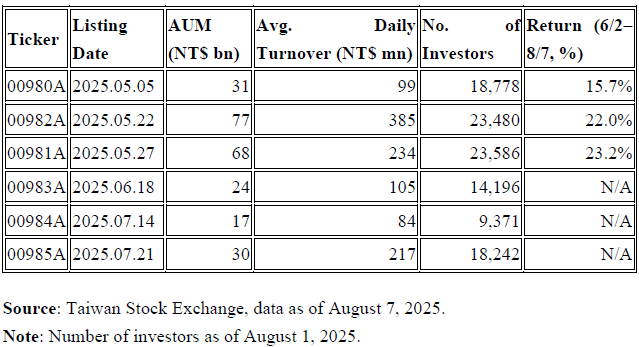
These six newly listed active ETFs each feature distinct strategies and broad investment scopes, covering both domestic and foreign equities, with diverse product types including market-cap-based and thematic approaches. They provide investors with a wide range of choices to meet different risk profiles and investment objectives, thereby enhancing both the breadth and depth of investor participation in the market. The strategies and features of each ETF are outlined below. For complete details, please refer to the respective prospectuses:
1. 00980A Nomura Taiwan Smart Select Active ETF
The Nomura Taiwan Smart Select Active ETF (Ticker: 00980A), issued by Nomura Asset Management, was officially listed on May 5, 2025, as the very first active ETF in Taiwan’s market. Its performance benchmark is the “Taiwan Stock Exchange Capitalization Weighted Stock Total Return Index.” The fund primarily applies quantitative models to construct a basket of Taiwan equities, with the objective of achieving long-term capital appreciation and delivering returns superior to its benchmark after expenses.
At least 70% of its assets will be invested in listed Taiwan companies with strong long-term growth potential and stable dividend-paying capacity. Its investment strategy covers both stock selection and portfolio management. For stock selection, Nomura combines its Taiwan equity research team’s fundamental analysis with proprietary quantitative tools to systematically screen candidates. On the portfolio management side, adjustments and rebalancing are carried out by considering macroeconomic conditions, industry cycles, market trends (such as liquidity and seasonality), strategic positioning, and risk budgeting.
2. 00982A Capital Taiwan Select Premium Active ETF
The Capital Taiwan Select Premium Active ETF (Ticker: 00982A), issued by Capital Investment Trust, was listed on May 22, 2025. This ETF emphasizes flexibility and adaptability, selecting potential outperformers in response to changes in macroeconomic conditions, industry outlook, and company fundamentals, with the goal of capturing excess returns in Taiwan equities.
Its assets are primarily allocated to listed Taiwan companies with solid operations and high growth potential. The strategy integrates both quantitative and qualitative elements: quantitative modules and qualitative assessments are dynamically adjusted based on market risks, industry outlook, and relative performance. Through this flexible allocation, the ETF seeks portfolio stability while maximizing performance across short-, medium-, and long-term horizons.
3. 00981A UPAMC Taiwan Growth Active ETF
The UPAMC Taiwan Growth Active ETF (Ticker: 00981A), launched by Uni-President Asset Management, was listed on May 27, 2025. It focuses on Taiwan’s top 300 market-cap companies, actively identifying industry development trends and selecting financially sound enterprises with technological leadership, innovation capabilities, and strong prospects for revenue and earnings growth, aiming to achieve long-term capital gains.
The investment strategy incorporates macroeconomic factors, government policies, and industry development directions, supplemented by liquidity, valuation, and technical indicators to ensure flexible portfolio management. Its performance benchmark is the “Taiwan Stock Exchange Capitalization Weighted Stock Index.”
4. 00983A CTBC ARK Innovation Active ETF
The CTBC ARK Innovation Active ETF (Ticker: 00983A), issued by CTBC Investment Trust, was listed on June 18, 2025. It introduces an international-level active stock-picking strategy and is Taiwan’s first active ETF with foreign securities as constituents.
This ETF focuses on the theme of “disruptive innovation,” primarily investing in U.S. companies with forward-looking technological potential. The investment universe includes, but is not limited to, robotics and automation, energy storage, artificial intelligence (AI), multi-omics/genomic sequencing, and blockchain. Companies are screened based on R&D and execution capabilities, competitive moats, market leadership, and valuation. The fund targets firms aligned with disruptive innovation that offer significant long-term growth opportunities.
CTBC has appointed ARK Invest (U.S.) as the overseas investment advisor to provide consultation and recommendations on investment strategies.
5. 00984A Allianz Global Investors Taiwan Dividend and Growth Equity Active ETF
The Allianz Global Investors Taiwan Dividend and Growth Equity Active ETF (Ticker: 00984A), issued by Allianz Global Investors Taiwan, was listed on July 14, 2025. Allianz has been active in Taiwan for over 35 years, known for its expertise in active asset management. As of July 14, it managed more than 300 funds available to Taiwanese investors (both domestic and offshore), with total assets exceeding NT$1 trillion.
This ETF represents both Allianz’s first entry into Taiwan’s ETF market and its very first active ETF globally. Its strategy combines high-dividend stocks (as the foundation for income) with growth-potential equities (to capture excess returns). Specifically, it invests in listed Taiwan equities using multiple stock selection strategies: core dividend strategy for identifying “high-dividend” stocks, fundamental momentum, value and low-volatility screening, price momentum, and research-based simulated portfolios for “growth-potential” stocks. At least 60% of the fund’s assets are allocated to stocks classified as either high-dividend or growth-potential.
6. 00985A Nomura Taiwan 50 Enhanced Equity Active ETF
The Nomura Taiwan 50 Enhanced Equity Active ETF (Ticker: 00985A), listed on July 21, 2025, is the second active ETF launched by Nomura Asset Management in Taiwan. Its performance benchmark is the “FTSE TWSE Taiwan 50 Total Return Index.”
This ETF employs quantitative models to optimize stock selection within a portfolio of 50 large-cap Taiwan blue-chip companies, aiming to outperform the benchmark after expenses. It focuses on large-cap leaders with strong competitive advantages and growth momentum. The strategy combines qualitative fundamental analysis with quantitative factor models to identify stocks with favorable earnings outlooks, solid financial stability, reasonable valuations, and positive trend momentum.
Domestic and International Asset Managers Actively Expanding Their Presence
1. Local Asset Managers Driving Diversified Active ETF Offerings
Taiwanese asset management companies have demonstrated strong enthusiasm and commitment in response to this emerging trend. Since regulators officially allowed active ETFs to be listed, multiple local asset managers have quickly responded by launching products that cover different strategies and asset classes. These range from Taiwan equity–focused thematic strategies, to U.S. innovation-driven sectors, to high-dividend strategies. This highlights both their innovation in product design and their sharp market awareness.
Such diversified product offerings not only reflect asset managers’ strong confidence in the growth potential of active ETFs, but also underscore their strategic intention to position these products as a key growth engine for the asset management industry over the next three to five years. In fact, as Taiwan’s ETF market continues to expand rapidly, capturing the next wave of capital inflows and investor attention has become a central theme in the business strategies of asset managers.
2. Enhancing Research Capabilities and Product Innovation to Build Competitive Advantage
The core competitiveness of active ETFs lies in the portfolio manager’s judgment of market trends and ability to operate with flexibility, which places higher demands on the professional capabilities of asset management companies. In response, many firms are dedicating more resources to strengthening internal research teams, enhancing their ability to analyze macroeconomic conditions, industry trends, and company fundamentals.
Furthermore, in order to cope with an increasingly dynamic market environment and heightened investor risk awareness, asset managers are actively establishing more robust risk management frameworks. Through systematic processes and institutional design, they aim to ensure stability and transparency in investment decisions. At the same time, continuous innovation in thematic investing and factor-based strategy design has helped build a dedicated product development system tailored to active ETFs. These efforts not only enhance the market competitiveness of individual asset managers but also inject new vitality into Taiwan’s asset management industry, effectively driving a shift from quantitative expansion to qualitative upgrading of investment products.
3. Global Asset Management Giants Accelerating Market Internationalization
Equally noteworthy is that the opening and early development of Taiwan’s active ETF market has drawn significant attention from leading international asset managers. Several global firms—including some of the world’s top ten asset managers—have expressed strong interest in the Taiwan market. Some have already begun market assessments and product preparation, while Allianz Global Investors has formally entered Taiwan’s active ETF market this year for the first time.
The participation of these international players not only brings more diversified product lines and management strategies but also introduces practical experience and asset allocation expertise from mature markets, helping Taiwan’s ETF market further align with global standards. Meanwhile, the entry of international brands will spur local firms to improve service quality and operational efficiency, fostering a more competitive, sound, and mature market environment overall.
Market Significance and Institutional Advantages of Active ETFs
1. Expanding the Depth and Breadth of the ETF Market
The introduction of active ETFs marks a shift in Taiwan’s ETF market from the previous phase of “quantitative expansion,” driven mainly by scale, toward a stage of “qualitative upgrading,” characterized by diversified strategies and refined management. With products that cater to different risk profiles and investment styles being launched, the market can now better serve a wide range of investor groups—from young retail investors to high-net-worth institutions—thereby broadening the investor base and injecting greater vitality into the capital market.
At the same time, active ETFs, through strategic stock selection and asset allocation by professional managers, not only enhance the trading volume and liquidity of Taiwan’s equity market but also, through more proactive portfolio management, strengthen the price discovery mechanism, ultimately improving overall market efficiency and depth.
2. Strengthening Taiwan’s Asset Management Competitiveness
The launch of this new category of ETFs not only provides fresh momentum for local asset management firms but also creates opportunities for international issuers to enter the Taiwan market. Several global asset managers have already participated, further expanding the scale of Taiwan’s ETF market and offering investors more diversified and specialized choices.
The presence of international brands—with their strong global influence and extensive resources—will help attract foreign capital to Taiwan’s market, thereby enhancing the visibility and liquidity of Taiwanese equities worldwide. In addition, the global perspectives and practical expertise that these international issuers bring will accelerate the internationalization of Taiwan’s market. Through cross-border cooperation, technical exchanges, and talent development, these contributions will not only foster institutional innovation but also strengthen the professional capabilities of local asset managers, building a globally competitive asset management ecosystem in Taiwan.
3. Balancing Development Between Active and Passive Funds
In recent years, Taiwan’s ETF market has grown rapidly, with the scale of passive ETFs already more than twice that of traditional mutual funds, underscoring their strong popularity among investors. The introduction of active ETFs provides greater flexibility in ETF operations, while also requiring asset managers to dedicate more resources to research and professional development. This plays a critical role in cultivating asset management talent and enhancing the overall competitiveness of the industry.
Moreover, it encourages the balanced development of both active and passive strategies within Taiwan’s fund market, ultimately fostering a healthier and more diversified asset management ecosystem.
The Role of the Taiwan Stock Exchange in Promoting Active ETFs
Before the policy liberalization of active ETFs and multi-asset passive ETFs, the TWSE worked closely with relevant agencies to support the competent authority in researching product structures, applicable regulations, and international practices. To ensure a sound institutional design, the TWSE also collected market feedback, referred to practices in advanced markets, and developed tailored supporting mechanisms based on the realities of Taiwan’s market.
Following the official policy announcement, the TWSE promptly completed internal operations and trading system adjustments, while also cooperating with the regulator to revise multiple rules and regulations. These revisions covered areas such as product issuance reviews, trading mechanism design, information disclosure standards, and market supervision rules. Step by step, this has built a comprehensive and forward-looking ETF operating framework that balances innovation with market stability.
At the same time, the TWSE has proactively offered “one-stop” project-based guidance services—covering application procedures, listing reviews, system integration, and market promotion—to help issuers smoothly launch new ETF products, accelerating product rollout and laying a foundation for their sustainable development.
Beyond product launches and system-building, the TWSE has also advanced investor education and market promotion in parallel. To help investors better understand the features and risks of these new types of ETFs, and to enhance their acceptance and willingness to participate, the TWSE, the Taipei Exchange, and the Securities Investment Trust & Consulting Association of the R.O.C. (SITCA), under the guidance of the regulator, jointly planned a series of promotional programs through multiple channels.
- Media outreach: Regular press releases and feature reports, as well as co-hosted large-scale forums with media partners, to increase visibility and market attention.
- In-person programs: Investor seminars, community college courses, and campus lectures to strengthen public understanding through interactive learning.
- Online resources: Integration of digital platforms such as the ETF Section on the TWSE Official Website, “e添富,” “Stay-at-Home Learning Network,” and Facebook to launch easy-to-understand infographics, digital materials, and online courses, making knowledge accessible anytime and anywhere while lowering participation barriers.
Through this dual-track approach of institutional development and investor education, the TWSE is committed to building a sound, diverse, and forward-looking ETF market ecosystem.
In addition, on June 30, 2025, SITCA, the TWSE, and the Taipei Exchange jointly launched the “Active ETF and Multi-Asset Passive ETF Education Website.” The site consists of four main sections: Home, Challenge and Win Prizes, Knowledge Workshop, and Related Links. It features explanations of product characteristics and risks, investment guides, FAQs, and search tools. To make learning more engaging, the website also incorporates 2D animations and interactive games, helping investors gain a clearer understanding of new ETF products in a lively and accessible way.
The TWSE also reminds investors to carefully read the prospectus before investing in active ETFs to fully understand their features and strategies, and to assess their own risk tolerance to ensure alignment with personal investment goals. In terms of risks, beyond those common to all ETFs, investors should recognize that the performance of active ETFs depends on the portfolio manager’s stock selection and management capabilities. Active ETFs do not guarantee outperformance against benchmarks or the broader market, and past performance does not represent future results.
Moreover, active ETFs in Taiwan adopt a “full transparency disclosure” model. After each business day’s NAV is calculated, asset management companies must disclose the actual portfolio holdings on their official websites, allowing investors to clearly monitor fund strategies. However, investors should note that due to the flexibility of active ETF management, portfolio managers may adjust holdings on the next business day. As such, intraday portfolios may differ from those disclosed the previous day, and the indicative intraday NAV may deviate from the actual NAV due to portfolio adjustments or exchange rate fluctuations. The final NAV should always be based on the official announcements of the fund manager.
Outlook for the Future
In recent years, Taiwan’s ETF market has demonstrated strong growth momentum and has gradually developed into one of the leading markets in Asia. With the proactive guidance of regulators, the concerted efforts of the TWSE, peripheral securities institutions, and industry participants, Taiwan has already achieved significant results in asset management development and is moving toward the goal of becoming an asset management hub in Asia. However, as global circumstances change rapidly and financial innovation never stops, we must continue to monitor international market trends, promote cross-border exchange cooperation, diversify product offerings, and further optimize the regulatory environment to ensure Taiwan’s asset management industry remains aligned with international standards.
1. Promoting International Exchange Cooperation
The TWSE has adopted a “regional-to-global” strategy to expand practical cooperation with international exchanges. In the Asia-Pacific region, it will continue to deepen ties with exchanges in Japan, Korea, and Singapore, covering areas such as product design, technical exchange, talent development, and joint marketing. This year, the TWSE is also hosting the 39th AOSEF Annual Meeting. Regarding ASEAN’s New Southbound markets, the TWSE will provide technical support and share experiences based on the needs of each exchange, establishing practical cooperation mechanisms. In addition, TWSE signed an MOU with the Dubai Exchange this year to jointly promote market development and broaden participation. On a broader global scale, the TWSE will actively participate in international organizations such as the WFE and IOSCO to raise the visibility and influence of Taiwan’s capital market and to open up more diverse cross-border collaboration opportunities.
2. Product Diversification
In terms of product innovation, Taiwan’s ETF market has evolved over more than 20 years, expanding product coverage to both domestic and foreign component securities ETFs. These range from market-capitalization-based and sector ETFs to Smart Beta ETFs, foreign securities ETFs invested in different countries, and leveraged and inverse ETFs. Beyond equities, product types now also include bond ETFs, futures-based commodity ETFs, and currency ETFs.
Historically, Taiwan’s ETF market has been concentrated on passive ETFs, but starting this year, several active ETFs have been introduced, filling the gap for actively managed strategies. Taiwan’s increasingly diverse ETF offerings meet the needs of different investors and help cultivate market recognition and acceptance of innovative products.
Furthermore, the Taiwan–Japan cross-border ETF will officially launch in Q3 2025, marking a new stage in the internationalization of Taiwan’s ETF market. Looking ahead, the TWSE will work with regulators to explore the feasibility of cross-border ETFs or related products with other regions and will actively support local issuers in launching products overseas that track Taiwan stock indices or are linked to Taiwan ETFs. The TWSE will also continue to collaborate with global index providers to develop thematic indices, enriching ETF product choices. Additionally, it will closely monitor the development of innovative products in global markets, such as fund-of-funds and target-date funds, and assess their applicability in Taiwan to further broaden the ETF product line.
3. Continuous Optimization of the Regulatory Environment
On the regulatory front, authorities have introduced multiple reform measures to enhance the international competitiveness of Taiwan’s ETF market. Beyond the opening of new product categories, continuous efforts have been made to optimize trading mechanisms. Since 2017, reforms have included the introduction of a dollar-cost averaging (DCA) system, the opening of intraday odd-lot trading in 2020, and more recently, the gradual shortening of odd-lot matching intervals. We observed that, by 2024, ETF investments made through DCA accounted for as much as 82% of total assets (compared with about 18% for stocks), with over half of participants aged between 21 and 40. This shows that ETFs have become the preferred tool for long-term investing. Trading mechanism improvements have effectively lowered entry barriers, enabling younger investors and those with smaller capital to participate in the market and build long-term investing habits and wealth.
To further strengthen market transparency and liquidity, TWSE will continue to work with regulators to review and refine relevant rules, such as adjustments to the dual-currency ETF trading mechanism, in order to provide investors with a healthier and more transparent investment environment.