
It Is a Legal Obligation for Practitioners to Continuously Receive On-the-job Training
To ensure that securities firm employees have a good level of business execution ability, the Financial Supervisory Commission (FSC), the regulatory authority for the securities market, stipulated in the “Regulations Governing Responsible Persons and Associated Persons of Securities Firms” that associated persons should participate in pre-employment training and on-the-job training conducted by designated institutions. Securities firms may also apply to hold on-the-job training on their own in accordance with the regulations on on-the-job training set by the Securities Association. Securities firms’ associated persons who have been employed for the first time or have resigned for at least 3 years before reappointment shall participate in pre-employment training within six months of their arrival; in-service employees should participate in on-the-job training every three years.
Based on this, the Taiwan Securities Association standardized the “Guidelines for On-the-Job Training of Securities Firms’ Associated Persons.” Securities firms’ associated persons should participate in on-the-job training from the date of registration, with a requirement of 15 hours every three years for entry-level personnel, advanced personnel, and mid-level supervisors, and the training should include regulatory training courses. For the training of senior executives above the level of vice president, the requirement is reduced to 7.5 hours every three years. In addition, securities firms may hold various professional training courses on their own according to actual business and personnel transformation needs, but the proportion of such self-organized training shall not exceed half of the total training hours, external training shall reach half of the total training hours, and no leave shall be allowed. If associated persons fail to participate in on-the-job training before the deadline, or if their on-the-job training results are unsatisfactory, supplementary training is required within one year. If the training results are still unsatisfactory, their associated person registration should be canceled.
Dedicated to Enhancing Links to Business and Complying With Laws and Regulations in the Advocating Team’s Tours Around the Island
Considering that regulations and business advocacy courses offered by the Taiwan TWSE Corporation (hereinafter referred to as the “TWSE”) or other securities related units can be used to offset the aforementioned on-the-job training for only up to three hours, to assist securities practitioners in improving their business capabilities and ensuring compliance with laws and regulations, the TWSE has been designing diversified advocacy courses over the years to introduce recent regulatory amendments, audit cases, trading system changes, and cyber security operations in the securities market, in order to convey comprehensive and real-time information. Therefore, the registration and attendance of securities industry practitioners have always been more enthusiastic than what the organizer expected, and there were many cases of practitioners waiting in a queue looking forward to participating after the registration quota is fully filled.
The aforementioned regulations and business advocacy courses held by the TWSE mainly target personnel who handle customer relationships on the front line of securities firms’ daily operations, that is, grassroots staff with rich practical experience, as the primary targets of advocacy and training. Based on this, the organizer has been spending tremendous manpower and resources every year to regularly hold large-scale events of this kind. The purpose is not only to promote new theoretical and practical knowledge, but also to take this opportunity to remind practitioners to carefully play their own roles anytime, anywhere. In addition to paying attention to various legal compliance requirements, they must also care for the rights and interests of investors, provide necessary assistance in a timely manner, prevent any possible illegal financial exploitation, and evaluate various financial products that are suitable for investors’ status and attributes based on differentiated factors such as customer age, investment ability, and investment experience.
The regulations and business advocacy meeting for securities firm employees was initially planned to be divided into stages in the first and second half of the year, with each stage independently handled. Personnel were sent to major cities in northern, central, and southern Taiwan for theme lectures, in order to provide intimate and convenient training services for local securities firms in each region. However, due to COVID-19 and other factors in the past few years, the TWSE simplified the scheduling and suspended the handling of the two stages in a year in compliance with the government’s pandemic prevention policy. After the pandemic prevention concerns were gradually eliminated recently, the TWSE announced in 2024 that it would resume the previous high advocacy frequency to facilitate the efficiency of frequent changes in securities laws and regulations, and conduct real-time advocacy for practitioners to maintain the efficiency and accuracy of information dissemination.
Totally 10 Sessions Were Held in the First Half of the Year, Exceeding the Performance Target Originally Set
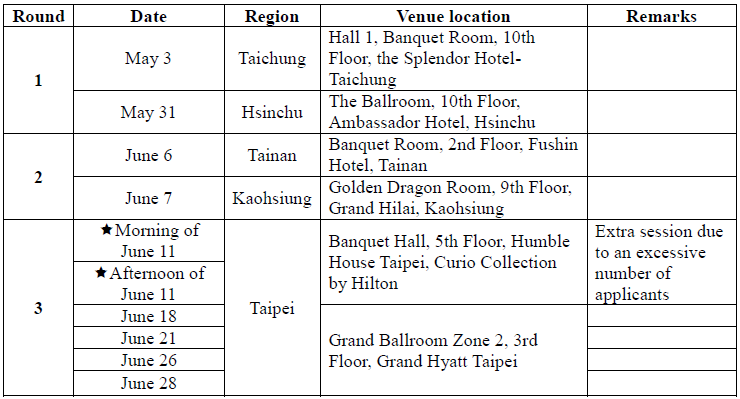
In May 2024, the TWSE launched the regulatory advocacy agenda for the first half of the year, which were divided into three rounds. There is a slight difference from previous years that the advocacy team did not start from Taipei this time as before, but instead chose to directly head south to Taichung as the first stop of the first round, and then turned around and headed north to Hsinchu, the cluster of the technology industry where the proportion of young people is extremely high. The second round was launched in early June, and the advocacy team traveled to Tainan and Kaohsiung. For the third round, the advocacy team originally scheduled to return to Taipei in late June and hold four consecutive sessions. However, due to unforeseen circumstances, a total of two additional sessions were held in the morning and afternoon of June 11, resulting in an unexpected increase of 25% to 10 sessions of the regulatory advocacy course for securities practitioners in the first half of the year, up from 8 sessions originally planned.
In the past, due to the established impression that the number of participants in the region was limited, Hsinchu, an emerging city, was never considered in the routine scheduling of securities regulations advocacy sessions for practitioners. The reason why this type of advocacy has recently received high attention from the outside world is due to the changes in the schedule starting from 2023. The TWSE has extended its service range in response to the needs of local securities firms, and added an additional session in the Hsinchu area. In other words, due to the industrial clustering effect triggered by TWSE/TPEx listed technology companies in Hsinchu, not only has the population moving into the area increased significantly, but the market for high-priced goods such as automobiles and real estate has also flourished. Securities firms have also gradually regarded high-asset customers in the Science Park as the focus of promoting their brokerage and wealth management businesses.
The TWSE has keenly observed the subtle market changes mentioned above, and quickly and decisively increased the number of sessions in Hsinchu, so that the growing number of securities firms in the area can send representatives to participate from nearby. At the same time, the sessions can also benefit the surrounding areas, allowing many securities firms located south of Taipei and north of Taichung to choose relatively close venues accordingly. This not only helps attending participants save travel expenses and time, and alleviate the hardships of travel and transportation, but also reduces the accumulated carbon emissions generated from the long-distance use of transportation, and assists in achieving Taiwan’s sustainable net-zero goal.
The regulatory advocacy course for securities firms in the first half of 2024 mainly focused on the interpretation of policies by the FSC and the Securities and Futures Bureau (SFB). The Securities Firms Division sent representatives to explain the “Recent Business Opening Focus and Regulatory Explanation,” which includes the scope of business relaxation, regulatory amendments, information security, protection of elderly customers, and prevention of financial fraud. As for the TWSE part, senior staff from the Intermediaries Service Department and the Trading Department took turns introducing “Common Business Deficiencies and Case Sharing,” “Securities Firm Information Security Operation Instructions,” “Instructions on Amendments to Securities Firm Management Regulations,” and “Key Points for Recent Trading Related System Changes.”
The professional advocacy team of the TWSE traveled to major cities in Taiwan for nearly two months in the second quarter of 2024, engaging in face-to-face communication and discussions with professionals in the securities industry, auditing, compliance, credit investigation, and entrusted services. Not only did they achieve the advocacy goal of eight sessions in the first half of the year, but they also over-achieved the goal with 10 sessions, with a lot of effort invested. As for the goal for the next stage, the advocacy team continued promoting a series of regulatory explanation events in the fourth quarter of the year to progressively increase the frequency and performance of advocacy, and strengthen the overall momentum and resilience of the securities market, striving to work together with regulatory authorities to promote financial service innovation and transformation.
Two Encore Sessions Were Added in Early June
According to the original plan, the TWSE should have held in total eight sessions of regulations and business advocacy courses for securities firm employees in the first half of 2024 in northern, central, and southern Taiwan from May 30 to June 28. Due to the capacity of each venue, the maximum number of applicants per session is set at 160 to avoid overcrowding and affecting the attendance experience of securities representatives from afar.
However, due to the wide range of courses offered at the advocacy meeting in the first half of the year which covered key recent business relaxations, trading system changes, information security operations, and regulatory amendments, as well as topics such as how to prevent the emergence of financial fraud and protect elderly investors, lecturers were invited from officials of the SFB under the SFC, and the Vice President of the TWSE led a professional advocacy team composed of senior staff from various departments to present each topic, in the hope that it would be helpful for practitioners to understand relevant regulations and practical operations, and protect the rights and interests of investors. As a result, the registration situation in the north was enthusiastic, far exceeding the initial estimate of the organizer.
Due to the unexpected overcrowding of applicants for the third round scheduled in June 2024, the originally booked venue was unable to accommodate the extra participants. To meet the demand of many aspiring practitioners, the conference hosting department, which had long been responsible for planning this business, made an unprecedented decision to increase the number of sessions and selected five-star hotel venues after coordinating the venue, budget, and lecturer selection. In early June, one session each was held in the morning and afternoon of the same day, totaling two sessions per day (see Table 1 for details), in order to smoothly accommodate the many securities practitioners in the north who previously failed to complete the registration process.
Typhoons Continued to Disrupt the Plan, Causing Some Sessions to Be Rescheduled
In the second half of 2024, due to natural disasters and other special circumstances, and after considering the decision of the local county and city governments to stop working and attending classes in accordance with Article 9 of the “Operation Regulations on the Suspension of Offices and Classes because of Natural Disasters,” the organizer had to postpone some originally scheduled sessions of the “Regulations and Business Advocacy Course for Securities Firm Employees” for the personal safety of attendees.
First, a strong typhoon named Krathon hit Taiwan at the end of September. The Central Weather Agency issued a typhoon warning for sea on the morning of September 29, and a typhoon warning for land in the early morning of September 30.The Intermediaries Service Department, the organizer of this event, started tracking the dynamic development of typhoon news in the first place to prepare contingency plans at any time. However, the did not land in Xiaogang, Kaohsiung until noon on October 3. It took more than 4 days from the release of the typhoon warning to the official landing, setting a record for the longest pre-landing warning in history. As a result, the securities participants in the southern region who were at the forefront were extremely worried about whether the advocacy session would be held as scheduled, regardless of the weather. The senior executives of the TWSE who had the authority to suspend the session also considered repeatedly whether to announce in advance the postponement to facilitate the response of securities participants in the southern region.
Finally, despite being 47 years away from the previous record of a typhoon landing in the area, in response to Typhoon Krathon, the second strong typhoon landing in Kaohsiung in nearly half a century, the organizer resolutely decided to suspend the Kaohsiung and Tainan sessions on October 3 to 4 before the government officially announced the news of the typhoon landing and did not immediately announce matters such as the date to which the event was postponed and the meeting venue until later. The emergency response measures finally came to an end after all participants who had completed their registration were promptly notified by designated personnel.
Coincidentally, after only about a month, another strong typhoon, Kong-rey, unusually hit Taiwan in winter time, deviating from the historical pattern of typhoons hitting Taiwan in the July to September period. Typhoon “Kong-rey” landed in Taitung County on the afternoon of October 31, causing a cumulative power outage of over 570,000 households nationwide, and up to 22 counties and cities announced a suspension of work and school classes. After a brief visit, “Kong-rey” left Taiwan from Yunlin County at around 6pm. However, according to the Central Weather Agency’s estimation, the impact might continue until the early morning of November 1, and the disaster situation in Taipei, the capital of Taiwan, was not light. There were multiple incidents of road tree collapses affecting traffic in various administrative regions. Therefore, the originally scheduled session at the Grand Hyatt Taipei on November 1 was temporarily suspended based on the previous experience with Typhoon “Krathon” to maintain the safety of attendees.
In the second half of the year, eight sessions were held non-stop, and we look forward to meeting again the following year after the final stop in Tainan
For the regulatory and business advocacy sessions for securities participants in the second half of 2024, the TWSE dispatched an advocacy team consisting of the Intermediaries Service Department and the Trading Department to Tainan on November 29, 2024 to conduct the 18th and final session of the year (see Table 2 for details). The sessions successfully concluded in Tainan with a strong sense of human touch, marking a perfect end to the two-stage series of the advocacy event throughout the year.
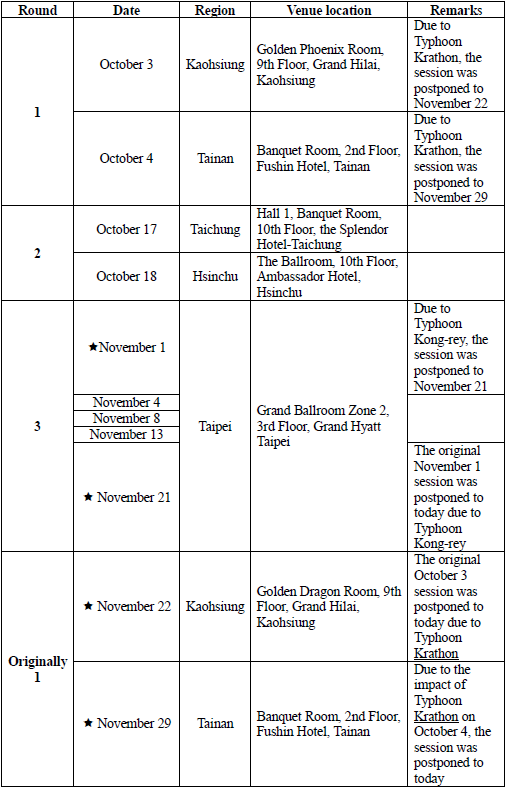
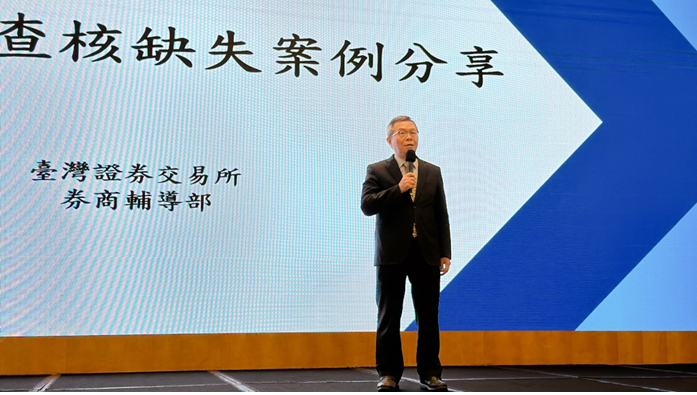
On the regulation and business advocacy for employees in the second half of the year, there were more sessions in Taipei, the newly added Hsinchu session in the previous year was maintained, and one session was still held in Taichung, Tainan, and Kaohsiung respectively. Chun-Chin Hsieh, Vice President of the TWSE, personally attended the Kaohsiung session at Grand Hilai (see Figure 1 for details). In addition to paying tribute to the attending guests, he took this rare opportunity to earnestly introduce the latest measures of the TWSE to practitioners, including the reform of the intraday odd lot trading system launched in December, which significantly shortened the matching interval from one minute to five seconds to improve trading efficiency and increase trading opportunities. In response to Chairman Sherman Lin’s strong emphasis on Innovation Board 2.0, the TWSE will launch four major benefits, including “lifting the restrictions on qualified investors,” “enhancing the rigor of innovation review,” “creating a flexible and friendly financing environment,” and “strengthening investor rights protection,” in order to encourage more investors to participate.
Returning to the Normal Two-stage Processing Mode, With Extremely Fruitful Results
To support the digital financial transformation, an online registration model is adopted for similar business advocacy events organized by the TWSE, and on-site registration is conducted with the QR code to greatly simplify the process. In order to assist Taiwan’s sustainable development and respond to the global environmental protection trend, the event team of the TWSE has long switched to paperless operations, and lectures and briefing data are all available in electronic format on its official website for participants to download and use on their mobile phones or tablets.
As for the course content, policy interpretation by the competent authority, the SFB, attracts the most attention from representatives of the securities industry. The TWSE also planned for the government agency that supervises the securities market to make a presentation in the final closing session. The SFB therefore appointed senior executives of its Securities Firms Division who were familiar with the business to take turns speaking at each session. In the advocacy sessions in the second half of the year, in line with the business opening schedule, the government representatives also significantly increased the content about new regulations, such as securities firms may accept “commissions from SICEs to execute computerized automatic rebalancing transactions for clients,” and securities firms are allowed to handle “subscription loans for TWSE/TPEx listed company employees’ subscription to capital increase through cash.” On the part presented by the TWSE, senior staff from the Intermediaries Service Department and the Trading Department were dispatched as usual to provide detailed introductions to business deficiencies and case study, explanations of information security operations, management regulations amendments, and trading related system changes.
Looking back at the securities regulations and business advocacy courses for the entire 2024, in May and June alone during the first half of the year, up to 10 intensive sessions were conducted, with the frequency and intensity being the highest in years. In the second half of the year, eight advocacy sessions were held as planned, and no room was allowed for the team members to slack off. After a long absence, the TWSE has once again returned to the normal processing mode, and after careful allocation of venues, locations, and times, the sessions were divided into two stages: the first and second half of the year, and advocacy related services were intensively promoted in different regions across the country. According to statistics, a total of 6 rounds and 18 advocacy sessions were held throughout 2024, with nearly 4,000 in-service personnel participating. In terms of both the number of participants and the distribution of sessions, they are almost twice that of 2023, and the performance is outstanding.