
With the rapid changes in the global capital market, the “intraday odd-lot trading” launched by the TWSE has become a new trend in investment which successfully lowers the investment threshold and allows more people, especially young people and investors with limited capital, to enter the market with ease. This mechanism not only provides investment flexibility, but also reflects the policy goal of inclusive finance to allow investors with different capital sizes to benefit from the growth of the Taiwan stock market.
Lowering the Investment Threshold - Background of the Implementation of the Intraday odd-lot trading
1. The number of high-price stocks continues to rise, raising the investment threshold
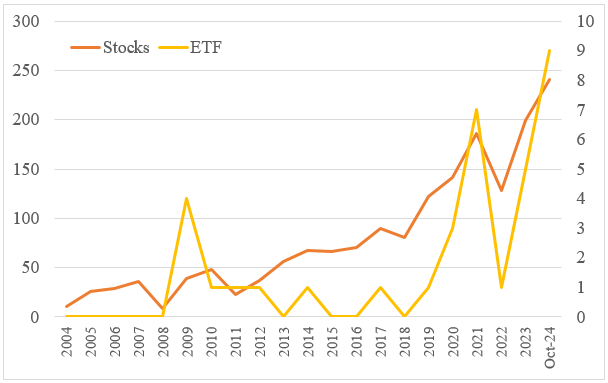
According to statistics, there were only 11 stocks with stock prices exceeding NT$100 in the centralized market in 2004. In the year before the introduction of the intraday odd-lot trading (i.e., the end of 2019), there were 122 stocks with stock prices exceeding NT$100, but as of the end of October 2024, the number of stocks with stock prices exceeding NT$100 has reached 250, and there are even 12 stocks with stock prices exceeding NT$1,000. With the continuous increase in the number of high-price stocks, the investment threshold has been raised, making it difficult for some investors with limited capital to enter the market. This means that under the regular trading session, many investors with limited capital find it difficult to invest in high-price stocks.
2. Implementing inclusive finance through the intraday odd-lot trading
To support the “inclusive finance” policy, the intraday odd-lot trading was officially launched on October 26, 2020 to allow investors to trade in units ranging from 1 to 999 shares during this trading session, without being limited by the one thousand share threshold. The trading system lowers the threshold for high-price stocks for small capital investors, and enables young people and small-capital investors to participate in the capital market more conveniently and share in the growth dividends of the Taiwan stock market.
Every penny counts - Implementation of the Intraday odd-lot trading
1. A significant increase in the intraday trading value and proportion of odd-lot shares
After the implementation of the intraday odd-lot trading on October 26, 2020, the daily average trading value was about NT$2.8 billion as of the end of October 2024, accounting for about 0.86% of the total trading value in the TWSE market. Adding the daily average trading value of NT$164 million for after-hours odd-lot trading, the daily average trading value of odd-lot trading was about NT$2.968 billion, accounting for about 0.91% of the total trading value in the TWSE market. Compared with that in the pre-implementation period (January to September 2020), the daily average trading value of after-hours odd-lot trading was about NT$223 million, accounting for about 0.12% of the total trading value in the TWSE market, which increased by nearly 12.57 times and 7.58 times respectively. This shows that both the trading value and proportion of odd-lot trading have significantly increased.
| Item | Intraday odd-lot trading | After-hours odd-lot trading | Total |
| Daily average trading value (in NT$100 million) | 28.04 | 1.64 | 29.68 |
| Percentage of total trading value in the centralized trading market | 0.86% | 0.05% | 0.91% |
2. Domestic retail investors account for over 80% of the trading value, and the number of accounts conducting odd-lot trading by investors under the age of 40 has significantly increased.
Observing the intraday odd-lot trading of various types of investors from the implementation date to the end of October 2024, it is found that domestic retail investors accounts for 82.5% of the trading value, domestic corporate accounts for about 3.6%, proprietary traders accounted for about 5.5%, SITEs accounts for about 0.2%, and foreign investors accounts for about 8.2% (as shown in Table 2). This shows that the intraday odd-lot trading market is dominated by domestic retail investors, which is in line with the expectation of the policy maker and the exchange.
| Investor type | Proportion of trading value (%) |
| Proprietary trader | 5.5 |
| Foreign investor | 8.2 |
| Domestic corporate | 3.6 |
| SITEs | 0.2 |
| Domestic retail investors | 82.5 |
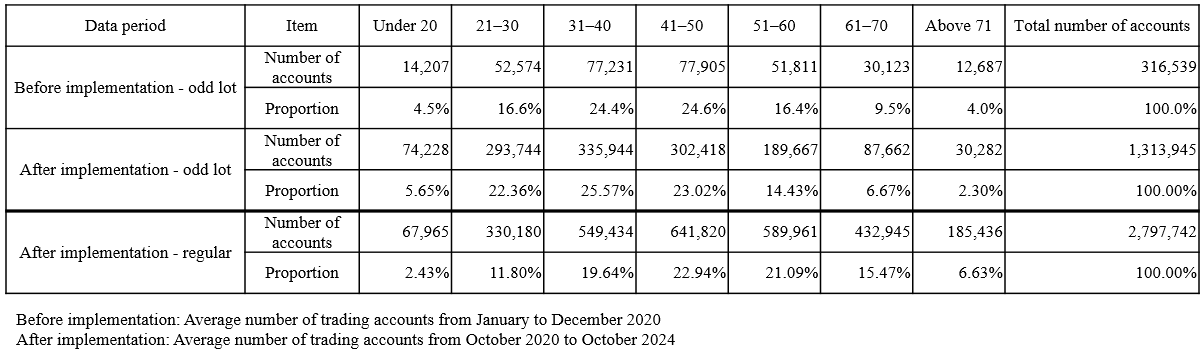
The number of retail investors engaging in intraday odd-lot trading has also increased significantly. Before the implementation, the average number of accounts that trade odd-lot share per month from January to September 2020 was 316,539 (as shown in Table 3), and after the implementation (from October 2020 to October 2024), the average number of accounts that trade odd-lot share per month was 1,313,945, a growth of more than four times. The top three age groups with the largest growth rate are all young people, with the first being retail investors aged 21 to 30, having a growth rate of 5.6 times, accounting for 22.36% of the odd-lot trading accounts. The age group with the second largest growth rate is retail investors under 20, having a growth rate of 5.2 times, accounting for 5.65% of the odd-lot trading accounts. The third is retail investors aged 31 to 40, having a growth rate of 4.4 times, accounting for 25.57% of the odd-lot trading accounts.
In addition, comparing the monthly structure of retail investor accounts in the regular trading session, after the implementation of intraday odd-lot trading, the proportion of retail investor accounts in the 21-30 and 31-40 age groups combined accounts for approximately 47.93%, which is significantly higher than the 31.44% in regular trading session. This indicates that the introduction of intraday odd-lot trading has indeed benefited the participation of younger and smaller investors in the stock market.
3. The investment targets of intraday odd-lot trading are mainly large-cap stocks
According to statistics, since its establishment till the end of October this year, the investment targets of intraday odd-lot trading are mainly large-cap stocks, with 58.4% concentrated in the constituents of FTSE TWSE Taiwan 50 Index, 18.8% concentrated in the constituents of FTSE TWSE Taiwan Mid-Cap 100 Index, and about 15.0% in other individual stocks. This indicates that the implementation of intraday odd-lot trading is beneficial for small-capital investors to invest in individual stocks with high investment thresholds.
| Target | Trading value distribution (%) |
| Stocks - FTSE TWSE Taiwan 50 Index | 58.4 |
| Stocks - FTSE TWSE Taiwan Mid-Cap 100 Index | 18.8 |
| Stocks - other | 15.0 |
| ETF - prototype | 6.3 |
| ETF - leveraged and inverse | 0.5 |
| TDR | 0.0 |
| Others (e.g. REITS) | 1.0 |
| Total | 100 |
4. Driving the growth rate of dollar-cost-averaging investment to multiply
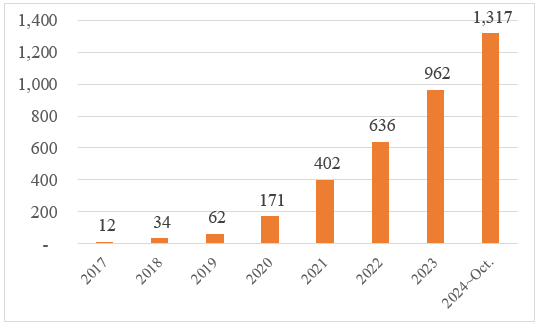
Since the implementation of intraday odd-lot trading, the monthly trading value and number of investors conducting dollar-cost-averaging investment have rapidly increased. Compared with the trading value of over NT$14 billion in October 2024, the trading value in the first month after the launch of dollar-cost-averaging investment was only NT$146,416. It can therefore be seen that using dollar-cost-averaging investment for long-term investment is increasingly favored by investors.
Striving for Excellence - Improvement Measures for Intraday odd-lot trading
After the implementation of the intraday odd-lot trading, multiple optimization measures have been taken to increase market liquidity, improve trading efficiency, and provide more real-time market information. The relevant measures are as follows:
1. December 19, 2022 - The matching interval was shortened from 3 minutes to 1 minute
Starting from December 19, 2022, the matching interval of intraday odd-lot trading was shortened from three minutes to one minute, which helped improve the trading efficiency of the intraday odd-lot share market, and increased trading opportunities for the implementation of inclusive finance.
2. November 27, 2023 - The information disclosure interval was shortened from 10 seconds to 5 seconds
To enhance the real-time nature of odd-lot share trading information, starting from November 27, 2023, the interval for disclosure of intraday odd-lot trial market information was shortened from 10 seconds to 5 seconds, in order to provide investors with more real-time and transparent market information, improve the reference for their buying and selling decisions, and enhance the odd-lot share trading market.
3. December 2, 2024 - The match interval was reduced from 1 minute to 5 seconds
To further increase the trading frequency of odd-lot shares, the matching interval of intraday odd-lot trading was shortened again from 1 minute to 5 seconds starting from December 2, 2024. It is expected that shortening the intraday odd-lot share matching interval to 5 seconds will further promote intraday odd-lot share liquidity and increase investment opportunities for intraday odd-lot trading.
Dual Forces of Inclusive Finance: Creating a New Era of Financial Access for All
In order to help more people establish correct investment and wealth management concepts, the TWSE actively promotes the intraday odd-lot trading to allow more small-capital investors to participate in the capital market easily. In the process of implementing the intraday odd-lot trading, the TWSE continuously observes market dynamics to not only actively improve the liquidity of the odd-lot share market, but continuously optimize trading convenience. In addition, the TWSE launched the dollar-cost-averaging investment in 2017 that is favored by investors, and has become an important method of long-term investment due to its convenience and risk diversification characteristics.
The successful implementation of intraday odd-lot trading and f dollar-cost-averaging investment fully demonstrates the efforts and achievements of Taiwan’s capital market in promoting nationwide investment. It not only marks that Taiwan’s capital market is moving towards the direction of inclusiveness and diversity, but also enables every investor to find a suitable wealth management method, achieves investment equality, and shares the benefits brought by inclusive finance.