
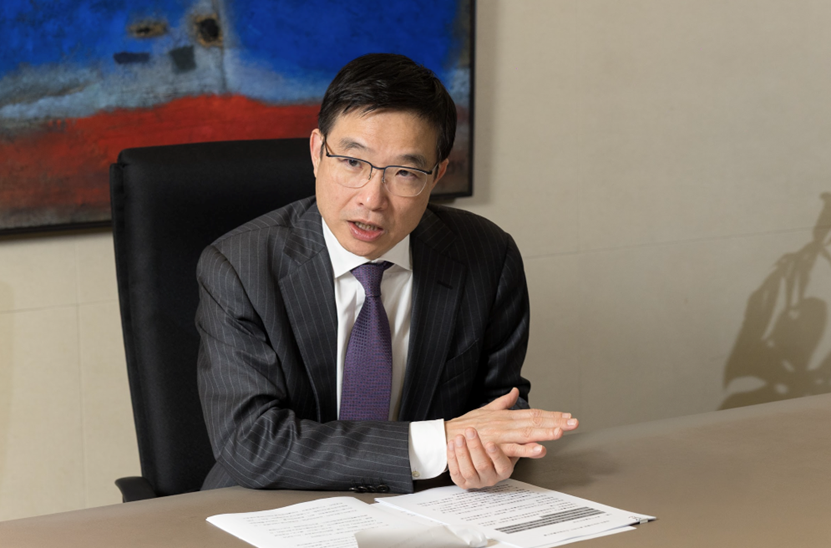
Taiwan’s startup fundraising ecosystem is accelerating, with total funds raised surpassing NT$100 billion last year, and the scale of startups tripling over the past decade. As industrial innovation momentum steadily accumulates, the government has set its next target, aiming to raise the scale of startup fundraising to US$5 billion by 2027. Chiu Te-cheng, Chairman of the Taiwan Venture Capital Association and Chairman of Top Taiwan Venture Capital, stated that with the establishment of “Asia Innovation Capital,” this opportunity will be greatly enhanced.
Chiu Te-cheng, who has spent nearly 40 years working in the capital markets, has experience spanning underwriting, investment, insurance management, and venture capital. He has long advocated that “Taiwan should establish a listing board akin to the U.S. NASDAQ.” Therefore, Chiu Te-cheng bluntly stated that Taiwan must completely abandon its traditional focus on profitability and view the Taiwan Innovation Board as “a capital market that embraces innovation and risk, which will become the nation’s most potent growth engine.” Through institutional innovation and international connections, Taiwan can be forged into an “Asian Innovation Mountain Range.”
Heading Toward the US$5 Billion Goal: Three Strategic Recommendations for the Asia Innovation Capital
Lessons from others can help refine our own approach. After analyzing the past 20 years, Chiu Te-cheng notes that the Nasdaq index has grown more than ten-fold, far outpacing the growth of the New York Stock Exchange. For Taiwan to achieve similar results, we must adopt the same mindset: “take risks, tolerate mistakes, and embrace innovation.” To achieve the target of US$5 billion in venture capital funding for Taiwanese startups by 2027, Chiu Te-cheng, from the perspective of the Taiwan Venture Capital Association, offers three strategic recommendations that could help Taiwan become a “capital market hub centered on technology.”
The first step is to align with Taiwan’s industrial strategy, which includes the six core strategic industries and the five trusted industry sectors. This alignment will enable international investors to clearly understand what Taiwan excels at and where it is heading, thereby naturally strengthening global confidence in Taiwan’s market. Second, a joint investment network should be built by linking international capital with local venture capital. Chiu Te-cheng stated, “Major venture capital and family offices in Asia are concentrated in Singapore and Hong Kong, but it is Taiwan that truly understands technology, manufacturing, and supply chains. Asia Innovation Capital can therefore leverage this advantage and fill in the missing piece of today’s regional capital landscape.”
The third recommendation centers on “establishing diverse exit routes to accelerate capital recycling.” Chiu Te-cheng firmly believes that a healthy venture capital ecosystem must offer multiple entry and exit routes. IPOs are one option, but mergers, acquisitions, and strategic investments are equally important. “‘We, the Taiwan Venture Capital Association, have specifically advocated for amendments to the Industrial Innovation Statute, aiming to expand the scope of juridical persons’ investment tax credits, extend the duration of startup investment incentives, and create more favorable incentives for exits through mergers and acquisitions, all of which help foster a healthy and positive ecosystem,’ Chiu Te-cheng added.”
Nurturing the Next Generation of the Magic Mountain range that Protects the Nation! How Can Taiwan Innovation Board 3.0 Accelerate Capital Circulation?
Taiwan cannot rely solely on the semiconductor industry for its strategy. We can see that in recent years, the country has been proactively developing the next-generation magic mountain range that protects the nation, focusing on AI, net-zero (green energy), biotechnology, cybersecurity and communications, and autonomous national defense. However, these fields share common characteristics: long R&D cycles, high capital intensity, and relatively high risk, making them even more in need of long-term capital support.
Chairman Chiu Te-cheng emphasized that the comprehensive deregulation under Taiwan Innovation Board 3.0 fills this long-missing “innovation puzzle” in Taiwan. By accelerating capital circulation, it becomes a key factor in nurturing the new magic mountain range that protects the nation. First, the lowered thresholds of Taiwan Innovation Board are expected to accelerate listings and enhance the visibility of growth trajectories. Chiu Te-cheng observed that, in the past, startups took an average of about 15 years from founding to listing. With the Taiwan Innovation Board, this period can now be shortened to 5 to 10 years. Coupled with a market mindset that embraces innovation and accepts risk, startups can access capital from the market much earlier.
Another advantage of Taiwan Innovation Board 3.0 is the strengthened market liquidity, which in turn gives venture capitalists confidence to invest. Chiu Te-cheng pointed out that for venture capital, “entry” and “exit” are equally important. Taiwan Innovation Board 3.0 allows both investment trust funds and general investors to participate. The introduction of day trading generates trading volume, enabling stock prices to more accurately reflect a company’s technology and growth potential. This ensures that shares can be bought, sold, and sold stably, giving venture capitalists more confidence to invest their money in the high-risk capital market.
In addition, Chiu Te-cheng believes that once Asia Innovation Capital is launched, the co-investment mechanism of the National Development Fund can also be adjusted accordingly. Currently, a 1:1 co-investment approach is mostly used. If the co-investment ratios could be relaxed to 1:2 or 1:3, policy funds could more effectively drive participation from private venture capital, CVC, family offices, and large corporations. At the same time, if investment targets could be expanded from domestic companies to high-quality overseas companies, it would help attract more international-level corporations to set up operations in Taiwan, engage in collaborative R&D, and even list on the stock market.
Therefore, Chiu Te-cheng affirmed: “The role of Taiwan Venture Capital Association is to help policy funds invest accurately, private capital keep up, and international resources be attracted into Taiwan.” Only when policy leads the way, venture capital amplifies, and industries are grounded in practice can the next-generation magic mountain range that protects Taiwan truly be nurtured.
Taiwan Venture Capital Association plays an important bridging role, turning “fresh capital” into “impact.”
With strategic recommendations and reforms to Taiwan Innovation Board, the Taiwan Venture Capital Association is also taking concrete actions, both internally and externally, to attract more fresh capital. Regarding domestic strategies, Chiu Te-cheng mentioned that the Taiwan Venture Capital Association serves as a bridge in promoting financial system reforms. The Association has advised the Financial Supervisory Commission to lower the risk coefficient for insurance companies investing in venture capital, encouraging more insurance funds to flow into early-stage and growth-stage industries. Additionally, they advocate for incorporating investments in startups as a bonus criterion in ESG/sustainability reports, thereby providing greater impetus for the investment strategies of Taiwan’s TWSE/TPEx listed companies and financial institutions.
As for international collaboration networks, Chiu Te-cheng explained that the Association’s members themselves constitute the strongest international investment network. In the past, Taiwanese venture capital firms and CVCs invested heavily in startups across Asia, the United States, Japan, and ASEAN. Now, the Association also brings these investment portfolios into the Taiwanese market through co-investments and strategic capital arrangements. In addition, the Association has begun collaborating with venture capital associations in Japan, Thailand, Vietnam, and Singapore. At the 2026 Venture Capital Annual Meeting, it plans to host the “Asia Venture Capital Forum,” inviting representatives from countries with mature venture ecosystems in Asia, the United States, and Israel to Taiwan for exchange. In addition, the Association will collaborate with the Taiwan Stock Exchange and the Taipei Exchange to jointly go abroad and attract business. By leveraging investments to create influence, it aims to realize Asia Innovation Capital's vision of “going into Asia and connecting globally.”
Regarding the ultimate positioning of the Asia Innovation Capital, Chiu Te-cheng once again called for Taiwan to build an Asian Innovation Mountain Range with a completely new vision and strategic perspective. He affirmed: “Taiwan is currently at a golden intersection in the innovation capital market. As long as the systems are in place, capital is willing to invest, and the direction of strategic industries is clear, Taiwan is fully capable of becoming Asia’s pivotal hub for startup investment!”