
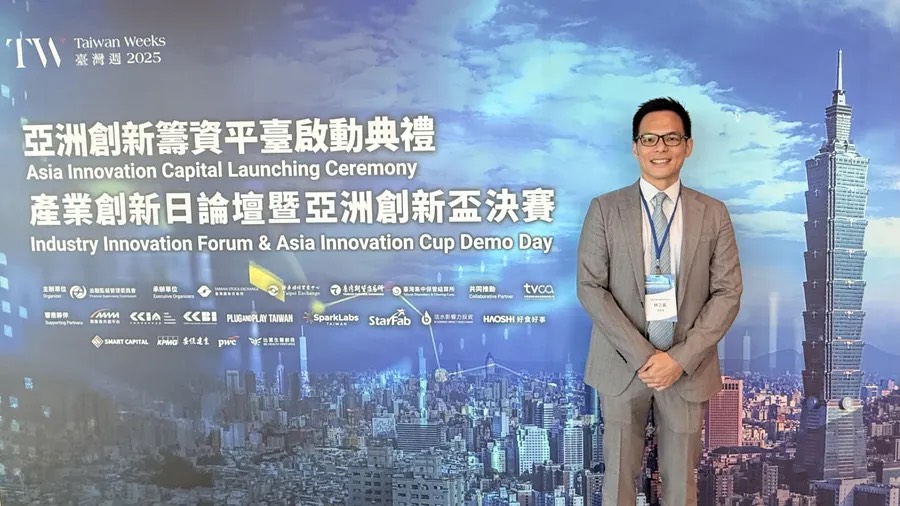
With the establishment of Asia Innovation Capital, what is its significance for Taiwan’s capital market and its role in connecting innovative energy? Jamie Lin, President of Taiwan Mobile and Chairman of AppWorks, provides firsthand insights from an industry perspective.
This year, the annual trend of TAIEX has shown a strong upward trajectory. According to data from the Taiwan Stock Exchange, as of the end of September, the total market capitalization of TWSE/TPEx listed companies reached NT$94.9 trillion, ranking 8th globally by country. What is the indicative significance of the establishment of Asia Innovation Capital for Taiwan’s capital market and its connection to global innovation? Jamie Lin, President of Taiwan Mobile and Chairman of AppWorks Accelerator, provides firsthand insights from an industry perspective.
The Financial Supervisory Commission, together with the Taiwan Stock Exchange and the Taipei Exchange, jointly launched Asia Innovation Capital, demonstrating the government’s determination to develop an Asia Nasdaq with distinctive Taiwanese characteristics. The platform features three key strengths: regulatory relaxation, a focus on strategic industries, and the implementation of a two-way market opening.
Regulatory Relaxation! Adjustments to Listing Rules for the Taiwan Innovation Board Companies and Foreign Companies in Taiwan
Jamie Lin, a leading venture capital figure deeply engaged in Asia’s startup ecosystem and focused on AI, cloud, and digital technology investments, expressed strong support for the new regulatory easing measures introduced by Asia Innovation Capital. According to the Taiwan Stock Exchange, the key areas of deregulation include: adopting the general board trading mechanism for the Innovation Board; refining listing requirements for domestic Taiwan Innovation Board companies; optimizing listing regulations for Taiwan Innovation Board companies and foreign General Board companies (abolishing the regulation that majority of directors shall be domiciled in the Republic of China); and introducing mechanisms that allow companies to transfer between the Taiwan Innovation Board, the TWSE General Board, and the TPEx-Listed Board.
Regarding the upgraded mechanism, Jamie Lin said, “Reforms in the capital market system are a crucial litmus test for Taiwanese tech companies aspiring to compete internationally. For any tech company seeking to go public, the key lies in having sufficient leverage and liquidity. Once they achieve healthy liquidity and strong valuation multiples, these companies will have the opportunity to use that leverage to pursue international mergers and acquisitions, thereby expanding their presence and influence across the region.”
Jamie Lin also believes that regulatory relaxation will provide a significant boost to Taiwan’s startups and high-quality enterprises as they expand abroad. He said, “Following the relaxation of investor eligibility requirements for Taiwan Innovation Board companies earlier this year, the establishment of Asia Innovation Capital continues that spirit of openness, which is a key initiative to enhance market liquidity. At the same time, we’ve observed that many Taiwanese entrepreneurs operating overseas may, through mergers or acquisitions, end up being classified as foreign companies. If these companies could eventually return to list on Taiwan’s capital market upon exit, it would greatly invigorate the market and further align Taiwan with international standards.”
Focusing on Key Industries, Capital Markets Boost AI Startup Opportunities
Another feature of Asia Innovation Capital is its focus on strategic industries, particularly semiconductors, artificial intelligence, AIoT technologies, smart manufacturing, green energy and environmental protection, robotics, digital cloud, smart transportation, smart health, biotech and medical care, cybersecurity, next-generation communications, drones, and defense and aerospace – all forward-looking sectors driving the new economy. At the same time, it has established a “Capital Market Service Team” and a “Single Service Window” to provide integrated support services.
Based on the review, these industries happen to align perfectly with the AppWorks ecosystem and Taiwan Mobile’s past focus areas, such as AI, the digital economy, cloud technology, and next-generation communications. Jamie Lin responded, “We are entering what is called the era of Agentic AI – essentially AI 3.0. Moving forward, all business models will evolve into “Business-to-AI-to-Consumer,” and eventually into “B2AI to AI2C.” Throughout this process, a multitude of new AI startup opportunities will emerge.”
Regarding the emerging sectors targeted by Asia Innovation Capital, Jamie Lin believes that whether through Taiwan Mobile’s own participation in these growth opportunities or by investing in startups and collaborating with them, there is an opportunity to capture growth in these fields. “We are pleased with the establishment of Asia Innovation Capital, because the capital market can support the development of such industries. We also hope that in the future, these startups we support will have the opportunity to go public, create liquidity, and generate good returns for entrepreneurs and shareholders,” he said.
Promoting Two-Way Openness, Supporting High-Quality Overseas Companies to Enter Taiwan’s Capital Market
The broader vision of Asia Innovation Capital is two-way openness: not only enabling Taiwanese companies to expand internationally, but also attracting high-quality international resources to connect with Taiwan, positioning the Taiwan Innovation Board as a central hub for innovative industries. Regarding these regulatory optimizations, Jamie Lin believes that Taiwanese investors should have the opportunity to invest in high-quality international startups and participate in their growth, as this can diversify their investment portfolios and provide potential wealth growth opportunities in the future.
On the other hand, Jamie Lin also mentioned that among their investments in Southeast Asia, several companies have market valuations approaching NT$10–20 billion. He pointed out clearly, “However, we’ve also observed that many Southeast Asian capital markets are relatively inactive. Whether it’s the Indonesia Stock Exchange (IDX) or the Singapore Exchange (SGX), both lack sufficient trading volume and are not particularly friendly toward technology stocks.”
In other words, Taiwan can learn from others’ mistakes to strengthen its own system. With the launch of Asia Innovation Capital, along with the Taiwan Stock Exchange’s upcoming relaxation of listing rules for both Taiwan Innovation Board companies and foreign companies, Jamie Lin firmly believes this initiative will not only provide strong leverage for Taiwanese companies engaging in overseas mergers and acquisitions but also attract more high-quality companies – especially those expanding abroad or aligned with technological trends – to return and list on Taiwan’s capital market. At the same time, it will allow local investors to participate in the growth of these leading companies, thereby enhancing the vitality of Taiwan’s capital market and further integrating it with global standards.