
I. Introduction
In recent years, the Singapore Government has actively implemented a range of initiatives aimed at revitalizing Singapore’s capital market. In addition to facilitating investment flows into the Singapore equity market through targeted initiatives and public funding support, the Government has introduced various measures, including reducing listing costs and providing tax incentives, to encourage companies to list on the Singapore Exchange (SGX).
This article provides an overview of SGX’s issuance market and reviews the various initiatives introduced since 2019 to encourage companies to list on SGX. It then focuses on the Global Listing Board (GLB) officially launched by SGX in June 2026, with the aim of examining international market frameworks and policy initiatives as references for the future development of Taiwan’s capital market.
II. Overview of SGX Cash Equity Market
1. Listing Board
Prior to the launch of the GLB in June 2026, SGX’s issuance market consisted of two listing boards: the Mainboard and Catalist. The Mainboard primarily targets larger and more established companies, while Catalist focuses on attracting growing companies seeking to list. Unlike the Mainboard, which imposes quantitative financial eligibility requirements for listing, Catalist does not prescribe similar financial entry criteria. Instead, companies seeking to list on Catalist are assessed and admitted through the sponsor regime.
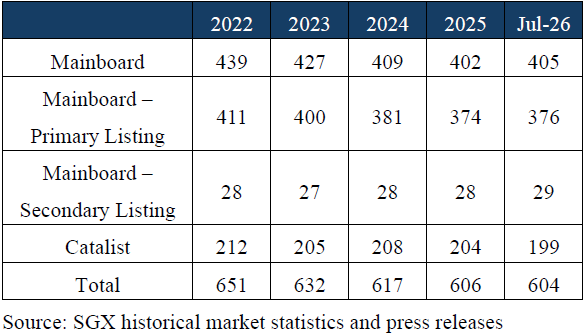
According to SGX’s monthly market statistics reports, as of the end of July 2026, there were 405 listed cash equities on the Mainboard and 199 listed cash equities on Catalist.[1] (See Table 1.)
In addition to companies whose primary listing is on SGX, companies already listed on other exchanges may apply for a secondary listing on the SGX Mainboard. In contrast, Catalist only permits primary listing. Since 2022, the number of secondary-listed issuers on the SGX Mainboard has consistently remained close to 30 listed securities. Looking at the distribution of primary listing locations of all companies currently secondarily listed on SGX, 19 companies are primarily listed in East Asia, 5 in Europe, 4 in North America, and one in Oceania.
[1] Under the classification of SGX, the cash equities cover ordinary shares, REITs and business trusts, but exclude exchange-traded funds (ETFs), company warrants, Daily Leverage Certificates (DLCs) and structured warrants.
2. Domestic and Foreign Listed Companies
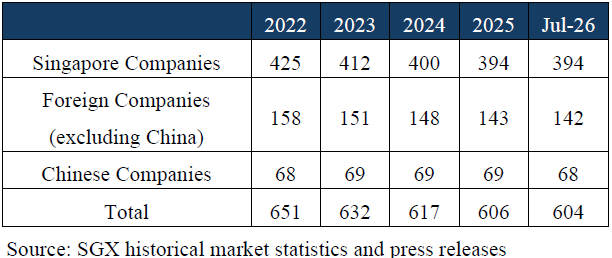
Foreign companies also account for a significant proportion of companies listed on SGX. As of the end of July 2026, foreign companies represented more than 30% of all companies listed on SGX. Among them, Chinese companies accounted for 68 listings, representing approximately 11% of total listed companies. This highlights China as an important source of listing applicants for SGX. (See Table 2.)
[2] The statistics cover ordinary shares, REITs and business trusts.
3. Conclusion
Overall, SGX currently has more than 600 listed cash equities, with the Mainboard accounting for approximately 70% of the total, while Catalist, which targets growing companies, accounts for around 30%. Foreign companies also represent an important component of SGX’s listed companies, accounting for approximately 30% of total listed companies. In addition, the number of secondary-listed companies on the SGX Mainboard is close to 30.
III. Analysis of SGX Cash Equities Listings
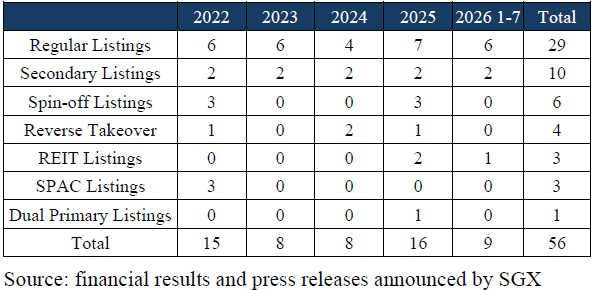
The number of new listings on SGX has recently increased. According to statistics compiled from SGX’s financial results and press releases, the number of new listings of cash equities[3] reached 16 in 2025 and 9 as of July 2026, representing a notable increase compared with 8 listings in both 2023 and 2024.
1. Listings by type
An analysis of the 56 new listings on SGX since 2022 shows that Regular Listings[4] accounted for the largest share, with 29 cases. The second largest category was secondary listings. Continuing listing obligations of secondarily listed companies are primarily aligned with the requirements of their primary listing exchanges, thereby reducing the additional compliance burden for secondary-listed companies in Singapore. From 2022 to July 2026, SGX recorded two secondary listings each year. Among the secondary listing cases since 2022, the exchanges on which these companies are primarily listed were mainly concentrated in the Hong Kong Stock Exchange (HKEX), with five out of the ten cases involving companies primarily listed in Hong Kong. Other primary listing exchanges include the New York Stock Exchange (NYSE), Nasdaq, and Bursa Malaysia.
The remaining cases involved restructuring-related listings, including spin-off listings and reverse takeovers (RTOs). Under the SGX Listing Rules, a reverse takeover refers to a situation where an acquisition of assets by a listed company results in a change in control of the listed company. In the event of a reverse takeover, the incoming business and the enlarged group following completion of the transaction must satisfy the relevant quantitative listing requirements and other applicable requirements. Spin-off listings refer to cases where an existing listed company separates a business operation and subsequently lists the spun-off entity.
Other listing categories include REITs listings, SPAC listings, and dual primary listings. Companies with dual primary listings are primary-listed on both exchanges and are therefore required to comply with the rules and requirements of both exchanges.
In 2025 and 2026, in addition to the increase in regular listing activities, other types of listings, including secondary listings, spin-off listings and reverse takeovers, also contributed to the growth in the number of cash equity listings on SGX. (See Table 3.)
[3] Under the classification of SGX, the cash equities cover ordinary shares, REITs and business trusts.
[4] Listings other than the types of listings illustrated below.
2. Listings by Board
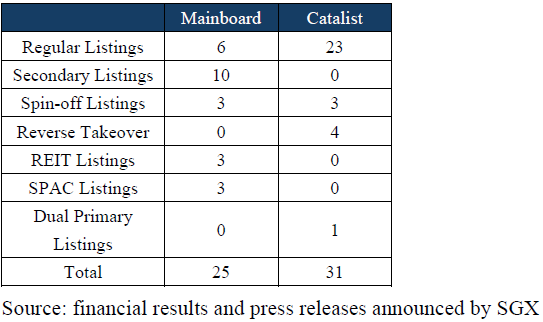
From the perspective of listing boards, Catalist has recorded more new listings than the Mainboard since 2022. Regular listings have also been concentrated on Catalist, with 23 out of the 29 regular listing cases occurring on Catalist, demonstrating that Catalist serves as an important source of new listings on SGX. In addition, all reverse takeover cases were conducted on Catalist, which is probably related to Catalist's more flexible listing requirements. The Mainboard’s primary source of new listings has been secondary listings. According to SGX’s listing rules, the frameworks for secondary listings, REIT listings and SPAC listings are available only on the Mainboard. (See Table 4.)
3. Conclusion
Overall, the increase in the number of listings on SGX in 2025 and 2026 was driven not only by the growth in regular listings but also by other types of listings, including secondary listings and restructuring-related listings. From the perspective of listing boards, Catalist has been an important source of overall listing activities. Meanwhile, secondary listings have been the primary source of listing activities on the Mainboard.
IV. Singapore’s Initiatives to Strengthen the Capital Market
1. Initiatives Overview
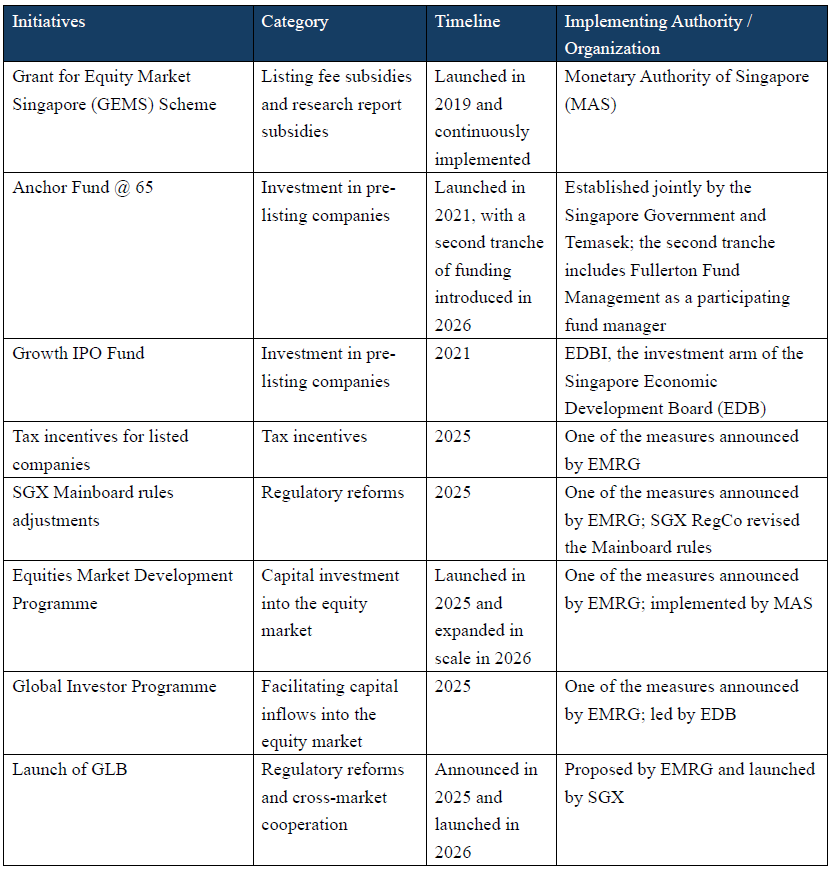
The Singapore Government has continued to introduce various initiatives to promote the growth of SGX’s issuance market. Since 2019, the Government has launched initiatives providing support for listing fees and research report costs. In 2021, the Government partnered with Temasek to establish a joint fund to invest in pre-listing companies. Furthermore, the Monetary Authority of Singapore (MAS) established the Equities Market Review Group (EMRG) in 2024, with the primary objective of proposing recommendations to revitalize Singapore’s capital market. The Group comprises representatives from both public and private sector institutions.
The Group introduced a series of policy recommendations in 2025, which have subsequently been implemented by relevant authorities and market stakeholders. These measures cover tax incentives for listed companies, adjustments to listing rules, as well as injecting public funds and mobilizing market capital into the equity market. The establishment of a dedicated taskforce and the continued implementation of market revitalization measures demonstrate the Singapore Government’s commitment to strengthening the development of its domestic capital market. A summary of Singapore’s capital market revitalization initiatives introduced since 2019 is provided in Table 5.
2. Initiative Highlights
Overall, the capital market revitalization initiatives could be classified into 3 categories described below:
(1) Make direct investments in pre-listing companies and support their preparations for going public.
a. Anchor Fund @ 65
The Anchor Fund @ 65 is a co-investment fund established by the Singapore Government and Temasek. The first tranche of the fund was launched with a size of S$1.5 billion, with the initial capital managed by 65 Equity Partners, Temasek’s investment platform. The fund primarily invests in companies preparing for future listings and supports their listing readiness. Its investment focus is on established high-growth companies, with the objective of facilitating their primary listings, secondary listings or dual listings on SGX. Supported by the fund initiative, two companies have completed secondary listings on SGX.
The second tranche of funding (Anchor Fund 2) was announced in 2026, with Fullerton Fund Management added as an additional fund manager.
b. Growth IPO Fund
The Growth IPO Fund and Anchor Fund @ 65 were investment initiatives announced during the same period. The Growth IPO Fund is managed by EDBI, the investment arm of the Singapore Economic Development Board (EDB). Similar to Anchor Fund @ 65, the fund invests in pre-listing companies. However, it focuses on companies that are still at least two rounds of fundraising away from a potential listing, serving as a financing bridge for companies transitioning from the growth stage to the mature profitability stage. The first tranche of the fund amounted to S$500 million.
(2) Reduce listing costs for companies and enhance their incentives to go public.
a. Grant for Equity Market Singapore Scheme
Launched by MAS, the scheme provides financial support to companies for listing-related expenses. Eligible expenses include underwriting, audit, legal services and intangible asset valuation costs. In addition, the scheme also provides subsidies for research reports, supporting financial institutions in publishing research reports on the equity market.
b. Tax Incentives for Listed Companies
Companies listed on SGX are eligible for tax rebates. Companies with a primary listing on SGX may receive a 20% corporate income tax rebate for five years from the month of successful listing. Companies conducting a secondary listing on SGX with new share issuance may receive a 10% corporate income tax rebate. Companies receiving the tax rebates are required to maintain their SGX listing status throughout the incentive period. In addition, the annual tax rebate is subject to a cap based on the company’s market capitalization.
c. SGX Mainboard Rules Adjustments
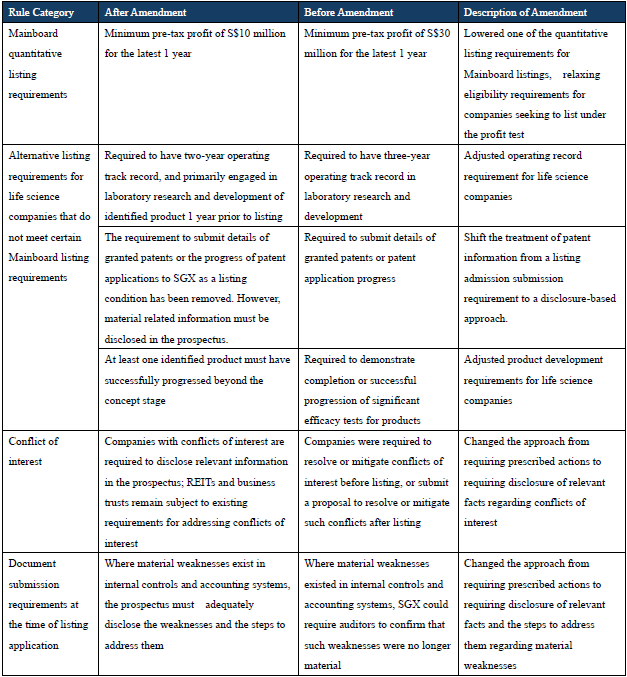
In October 2025, Singapore Exchange Regulation (SGX RegCo), a wholly owned subsidiary of SGX, announced adjustments to the Mainboard Rules. The reforms strengthened the capital market’s transition towards a more disclosure-based regulatory approach. The reforms covered areas including the lowering of profit requirements for listing, the transition from mandatory execution requirements towards a more disclosure-based regime, and enhanced post-listing supervision. The key related rule amendments are summarized in the table 6.
(3) Ensure a continued flow of capital into the capital market
a. Equities Market Development Programme
In February 2025, MAS announced the Equities Market Development Programme (EQDP), under which S$5 billion was planned to be invested in asset management companies. The funds would be primarily allocated to asset managers investing mainly in Singapore-listed equities, with a focus on small- and mid-cap stocks. The first and second tranches of funding were allocated to asset managers in July and November 2025, respectively, with total committed investments reaching S$3.95 billion. In February 2026, MAS further expanded the scale of EQDP by increasing the planned investment amount by an additional S$1.5 billion.
b. Global Investor Programme
The Global Investor Programme (GIP) is administered by EDB. The program aims to grant Singapore Permanent Resident (PR) status to global investors seeking to establish businesses and make investments in Singapore. Eligible GIP applicants include business owners and family office principals. Applicants may select from different investment options to satisfy the required investment criteria in Singapore. Under Option C, applicants are required to establish a family office in Singapore and invest at least S$50 million in SGX-listed equities.
3. Conclusion
Overall, Singapore’s capital market revitalization initiatives provide comprehensive support for companies seeking to list on the SGX while ensuring a continued flow of capital into the market. In addition, the scope of these initiatives covers secondary-listed companies and small- and mid-cap companies, reflecting that secondary listings and Catalist, which primarily targets growing companies, remain important components of Singapore’s ongoing capital market development strategy.
V. Global Listing Board
As part of a series of measures to strengthen Singapore’s capital market, MAS announced in November 2025 that SGX would establish a dual listing framework with Nasdaq, providing companies with a channel to raise capital simultaneously in both markets. The initiative targets growth companies with business or other connections to Asia with a market capitalization of at least S$2 billion.
1. Operating Mechanism of the Global Listing Board
The framework officially took effect in June 2026. The newly launched Global Listing Board (GLB) provides companies with a pathway to concurrently apply for listings on the Nasdaq Global Select Market and SGX.
The framework does not allow a company listed on one exchange to automatically obtain a listing on the other exchange, nor does it enable a company to achieve dual listing by submitting a single application to only one exchange. Instead, the framework coordinates the application timelines and procedures for listing on GLB and the Nasdaq Global Select Market, enabling companies to complete listings on both exchanges within a similar timeframe.
Following the completion of a dual listing, the Nasdaq Global Select Market serves as the company’s primary listing venue. Companies listed on GLB are required to maintain their primary listing status on the Nasdaq Global Select Market.
2. Target Companies of GLB
GLB targets companies with business and other connections to Asia, enabling them to access the US capital market while also having the option to list on SGX through a coordinated listing process between SGX and Nasdaq. Through participation in both capital markets, companies may enhance their visibility and expand market exposure across both jurisdictions.
3. Distinction Between the Global Listing Board and the Existing Secondary Listing Framework
Although both GLB and SGX’s existing secondary listing framework require companies to maintain their primary listing status on a foreign exchange, the two frameworks differ in several aspects.
SGX established GLB as a separate listing board for companies pursuing dual listings with Nasdaq, distinct from the existing Mainboard and Catalist structures. This separates GLB from secondary listing, which is regulated in the Mainboard Rules.
(1) Quantitative Listing Requirements
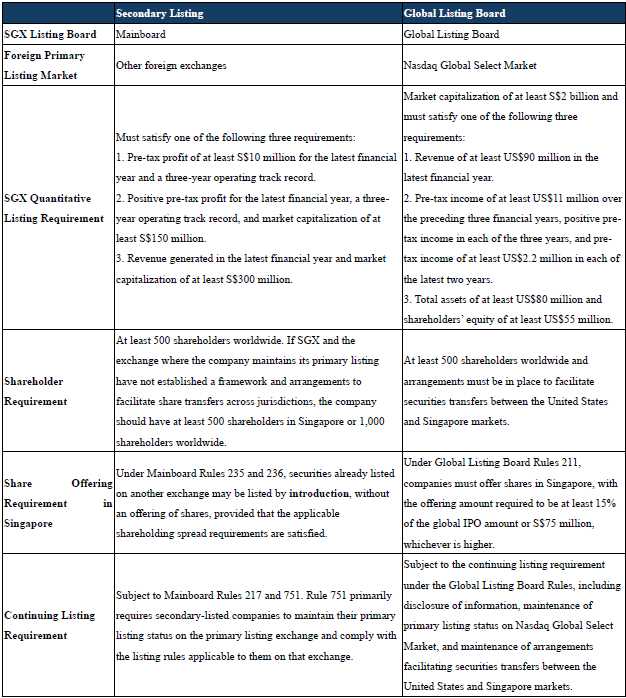
In addition to establishing a separate listing board and rules to distinguish the two mechanisms, GLB and secondary listing differ across various requirements (see Table 7).
First, regarding quantitative requirements, GLB does not prescribe a three-year operating track record requirement. Although one of the profit eligibility criteria requires companies to meet a pre-tax income threshold over the preceding three years, the Practice Note under GLB Rules clarifies that companies may satisfy this criterion with less than three years of operating history under specific circumstances.
While the required length of operating history has been reduced, the market capitalization requirement has been significantly increased. This indicates that, compared with the existing Mainboard secondary listing framework, GLB places greater emphasis on company scale.
(2) Shareholder Requirement
Second, regarding shareholder requirement, although GLB also requires a minimum of 500 shareholders worldwide, companies must have arrangements facilitating the transfer of securities between the United States and Singapore markets.
For secondary listing, if there is no framework or arrangements in place to facilitate share transfers between the two markets, the number of shareholders worldwide required will increase, or companies should have shareholders in Singapore.
(3) Share Offering Requirement
Third, regarding Singapore share offering requirement, the Mainboard rules allow companies applying secondary listing by way of introduction, without an offering of shares at the time of listing.
In contrast, companies listed on GLB are required to offer shares in Singapore and must satisfy a prescribed minimum offering amount.
4. Conclusion
Overall, although GLB shares certain similarities with the Mainboard secondary listing framework, it establishes a separate listing board with differentiated requirements in areas including quantitative listing criteria, shareholder requirements and share offering requirements.
GLB is designed around a market capitalization-oriented approach, arrangements to facilitate securities transfers between the two markets, and requirement for local share offerings in Singapore.
VI. Conclusion
Regarding listing boards and the jurisdictions of listed companies, although the Mainboard and Singapore-incorporated companies remain the predominant components of SGX’s market, Catalist and foreign companies listing on SGX have become important contributors to the number of listed cash equities in Singapore’s market.
In terms of cash equities listings on SGX, the number of listings increased in 2025 and 2026, accompanied by greater diversity in listing types. From the perspective of listing boards, Catalist listings accounted for more than 50% of cumulative listing activities since 2022.
Singapore government and SGX have continued to actively promote capital market development through a wide range of initiatives. In addition to investing in and facilitating capital inflows into the Singapore equity market, Singapore has introduced diversified initiatives to encourage and facilitate listings on SGX. Through investments in pre-listing companies, listing fee subsidies, tax incentives for listed companies, and listing framework reforms, these measures aim to enhance SGX’s attractiveness as a listing venue for companies worldwide.
SGX has also actively expanded channels for sourcing new listings. In June 2026, SGX officially launched GLB, providing companies with a pathway to concurrently apply for listings on Nasdaq and SGX through coordinated timelines and application procedures. The framework targets companies with business and other connections to Asia and establishes arrangements to facilitate securities transfers between the two markets.
The newly introduced GLB framework differs from the existing secondary listing framework and provides global enterprises with additional avenues to participate in the capital market. The future development of the GLB, including actual listing cases and the effectiveness of its implementation, warrants continued observation.