
Introduction: The Evolving Role of Margin Trading Amid Structural Market Change
In 2026, the TWSE-listed market demonstrated robust growth momentum. Driven by core industries such as semiconductors and the artificial intelligence (AI) supply chain, the Taiwan Stock Exchange Capitalization Weighted Stock Index (TAIEX) has repeatedly hit record highs, rising to 43,119.75 points by the end of July 2026 — a surge of nearly 50% year-to-date. Cumulative trading value reached NT$141.85 trillion, surpassing the full-year level recorded in 2025 in just seven months, while the total market capitalization of the TWSE-listed market rose to NT$140.85 trillion as of the end of July 2026.
Fueled by simultaneous increases in the index and trading activity, the margin loan balance in the TWSE-listed market also rose, reaching a record high of NT$631.3 billion on July 6, 2026. Coupled with recent foreign media reports indicating that over 1.2 million trading accounts in South Korea triggered margin call thresholds during a deleveraging wave in July of this year, global stock market volatility has heightened attention toward Taiwan’s margin trading leverage and concentration risks.
This article examines the actual increase in margin loans from the perspectives of overall market structure, margin loans by industry, investor composition, and margin trading indicators. It further analyzes the relationship between the margin loan balance and market size, industry concentration, and investor leverage utilization, aiming to understand the market shifts and potential risks reflected by the record-high margin loan balance.
Margin Loan Balance Reaches Record High, While Leverage Level Remains Low
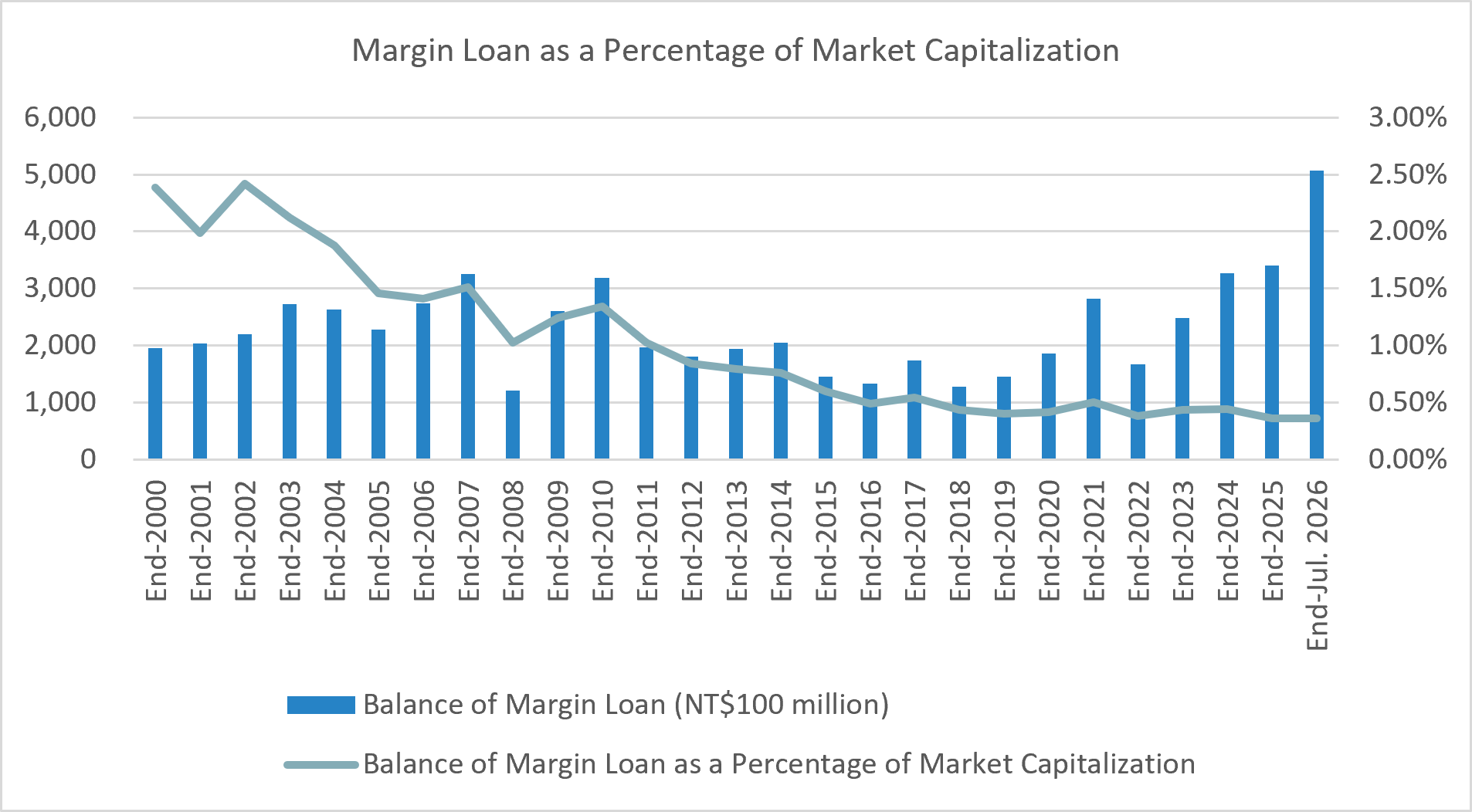
Looking back over the past 30 years, the margin loan balance in the TWSE-listed market reached a historical peak of NT$593.6 billion in April 2000. However, as the dot-com bubble burst and market conditions reversed, the balance fell to NT$195.5 billion by the end of that year. In 2026, the margin loan balance repeatedly reached new highs, peaking at NT$631.3 billion on July 6 and falling back to NT$502.6 billion at the end of July.
At the same time, the total market capitalization of listed companies expanded substantially, standing at NT$140.85 trillion at the end of July 2026 — more than ten times the NT$12.65 trillion recorded at the end of April 2000. Accordingly, the increase in margin loan balances in 2026 primarily accompanied the overall growth of Taiwan’s market, driven by the competitive advantages of its industries, with the margin loan balance naturally reflecting stock prices and overall market size.
A further comparison of the margin loan balance as a percentage of total market capitalization in the two periods, however, presents a different picture. The ratio was approximately 4.69% in April 2000, compared with only approximately 0.41% on July 6, 2026, and 0.36% at the end of July. Moreover, the ratio has remained relatively stable over the past three years, indicating that levels of margin leverage remain relatively low, with no rapid expansion.
Diversified Investment Instruments Diminish the Relative Share of Margin Trading
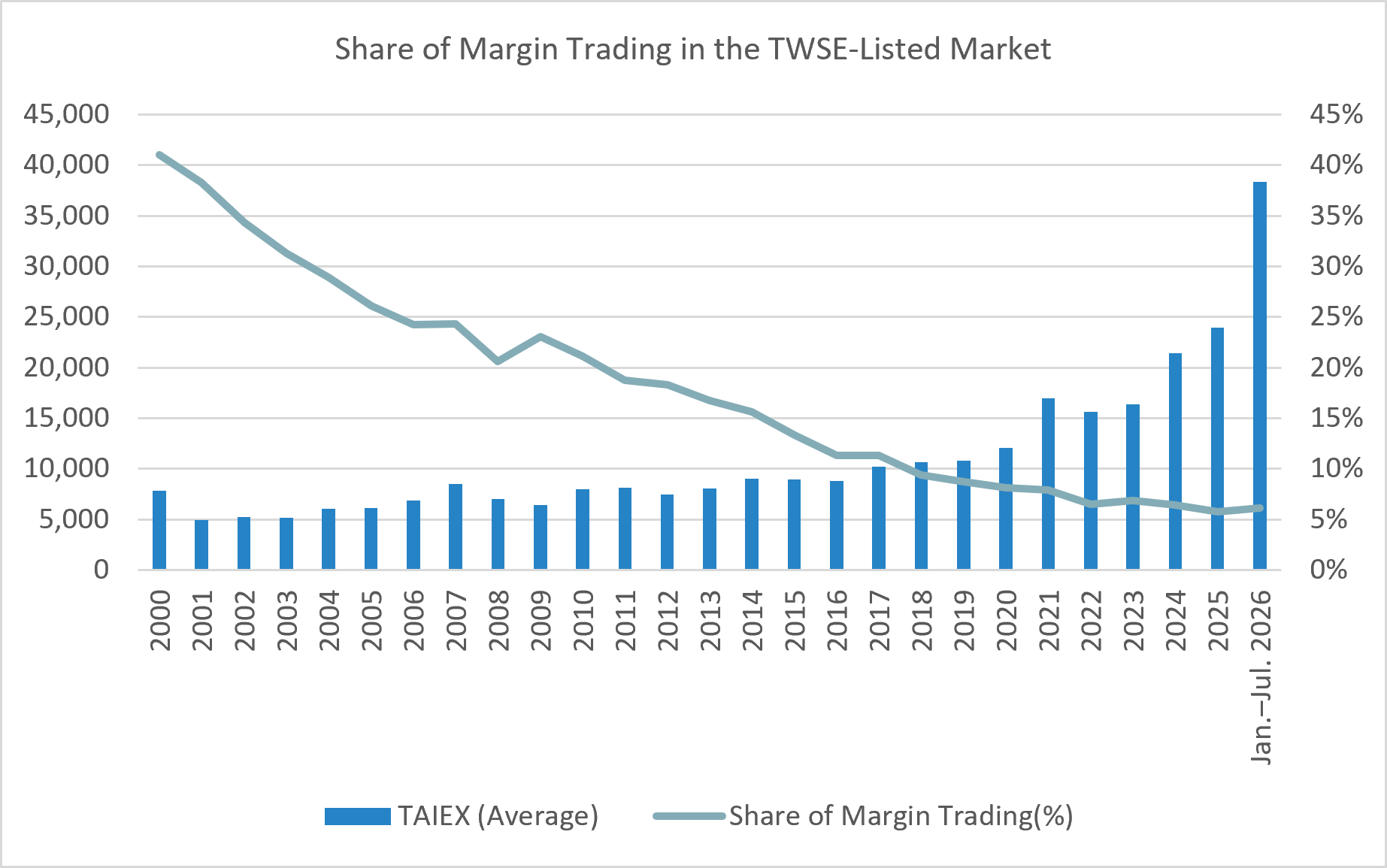
In the past, available market trading instruments were limited, making margin trading a crucial market component. In 2000, margin trading accounted for approximately 40% of total market trading value.
With the ongoing development of Taiwan’s capital market, diverse investment instruments such as ETFs, warrants, futures, and options have progressively gained popularity, alongside the development of day-trading and securities lending. As investors gained access to a broader range of investment and trading vehicles, the proportion of margin trading in total market turnover steadily declined, dropping from 13.32% in 2015 to 5.78% in 2025, and stood at approximately 6.09% from January through July 2026.
This indicates that, as market trading patterns have become increasingly diversified, the influence of margin trading on the overall market has declined significantly compared with the past. Furthermore, the ratio has also remained stable at approximately 6% over the past three years, showing no rapid expansion of margin leverage.
Shifts in Investor Structure Limit the Market Impact of Margin Trading
Beyond the diversification of trading instruments, the structural changes in market participants are also a major factor behind the declining influence of margin trading. Historically, market participants were heavily concentrated among retail investors, with individual investors accounting for up to 86.1% of total trading value in the TWSE-listed market in 2000.
However, as the investment weight of institutional investors has continued to rise, together with the growing adoption of trading channels such as intraday odd-lot trading, regular savings plans, and passive investment through ETFs, barriers to market participation have been lowered, encouraging greater participation by younger investors and various categories of long-term investors. Driven by the momentum of institutional capital, the overall market structure has become increasingly institutionalized, causing the trading turnover share of domestic individual investors to drop to approximately 52% from January through July 2026.
By contrast, participants in margin trading remain highly concentrated among domestic individual investors. As of the end of July 2026, individual investors accounted for more than 98% of margin trading, while institutional participation remained limited. In other words, the overall market trading structure has become more diversified as institutional participation has increased, whereas margin trading continues to be dominated by individual investors. This concentration in participant composition, together with the continuing decline in margin trading as a share of overall market trading value, indicates that the role of margin trading in the market has diminished compared with the past.
Margin Loan Balances Concentrated in Specific Sectors, Yet Relative Shares Remain Limited
The preceding data show that the share of margin trading in the overall market has visibly declined. To further evaluate whether concentration exists in particular industries, it is also necessary to examine the distribution of margin loan balances across industries and compare such balances with their respective market capitalizations.
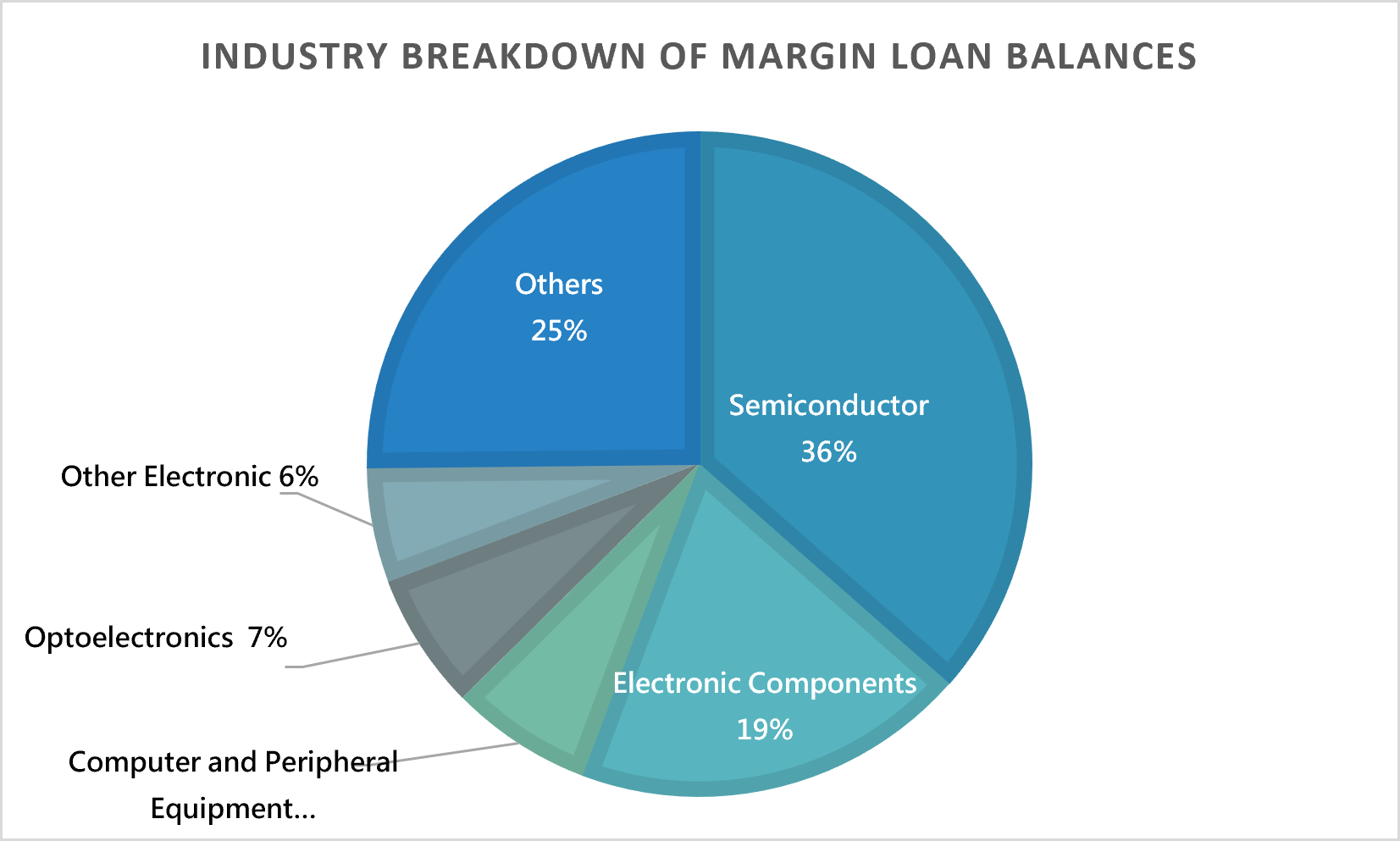
As of July 31, 2026, margin loan balances were concentrated primarily in electronics-related industries. Semiconductors and electronic components were the top two industries by margin balances, accounting for 36% and 19% of the total, respectively. The computer and peripheral equipment industry and the optoelectronics industry each accounted for 7%, while other electronic industries accounted for 6%. In total, electronics-related industries represented 75%, with remaining industries accounting for the other 25%.
The industrial breakdown of margin loan balances reflects not only investor allocation preferences but is also influenced by the market capitalization and trading scale of each sector. On July 31, 2026, margin loan balances for semiconductor and electronic components accounted for 0.23% and 0.73% of their respective sector’s market capitalizations, both below 1%. From January through July 2026, margin trading value in these two sectors accounted for only 2.76% and 1.63% of total trading value in the TWSE-listed market, respectively.
Evaluating industrial margin balances, market capitalizations, and trading values collectively reveals that while semiconductor and electronic component sectors hold higher absolute margin balances, their margin leverage penetration remains limited relative to their massive market capitalization and overall trading scale. There is currently no evidence of excessive leverage or unbalanced concentration risks in specific industries.
Overall Collateral Levels Remain Adequate, While Margin Calls and Liquidations Remain Manageable
Overall collateral coverage remained solid: the market-wide maintenance margin ratio ranged from 160.33% (the lowest, on July 30, 2026) to 211.45% (the highest, on May 26, 2026), averaging 190.04% from January to July 2026 — with even the low point staying well above the 130% margin-call threshold. As of July 31, 2026, the ratio stood at approximately 172.90%, indicating that collateral conditions continued to provide a healthy buffer.
In terms of actual margin calls and forced liquidations, average daily margin calls totaled NT$97 million and average daily forced liquidations totaled NT$33 million between January and July 2026. Compared to the concurrent margin loan balances and average daily trading turnover, these proportions are minimal, exerting limited impact on the market.
As of the end of July 2026, the TWSE-listed market had approximately 14.6 million trading account holders, of whom approximately 170,000 had outstanding margin loan balances, representing approximately 1.2% of the total. In July of the same year, the average daily number of accounts receiving margin calls was 728. Evaluating active margin participants, margin call accounts, and liquidation amounts indicates that Taiwan’s stock market has not experienced widespread or cascading forced liquidations.
Margin Trading Participant Profiles and Liquidation Risk Distribution
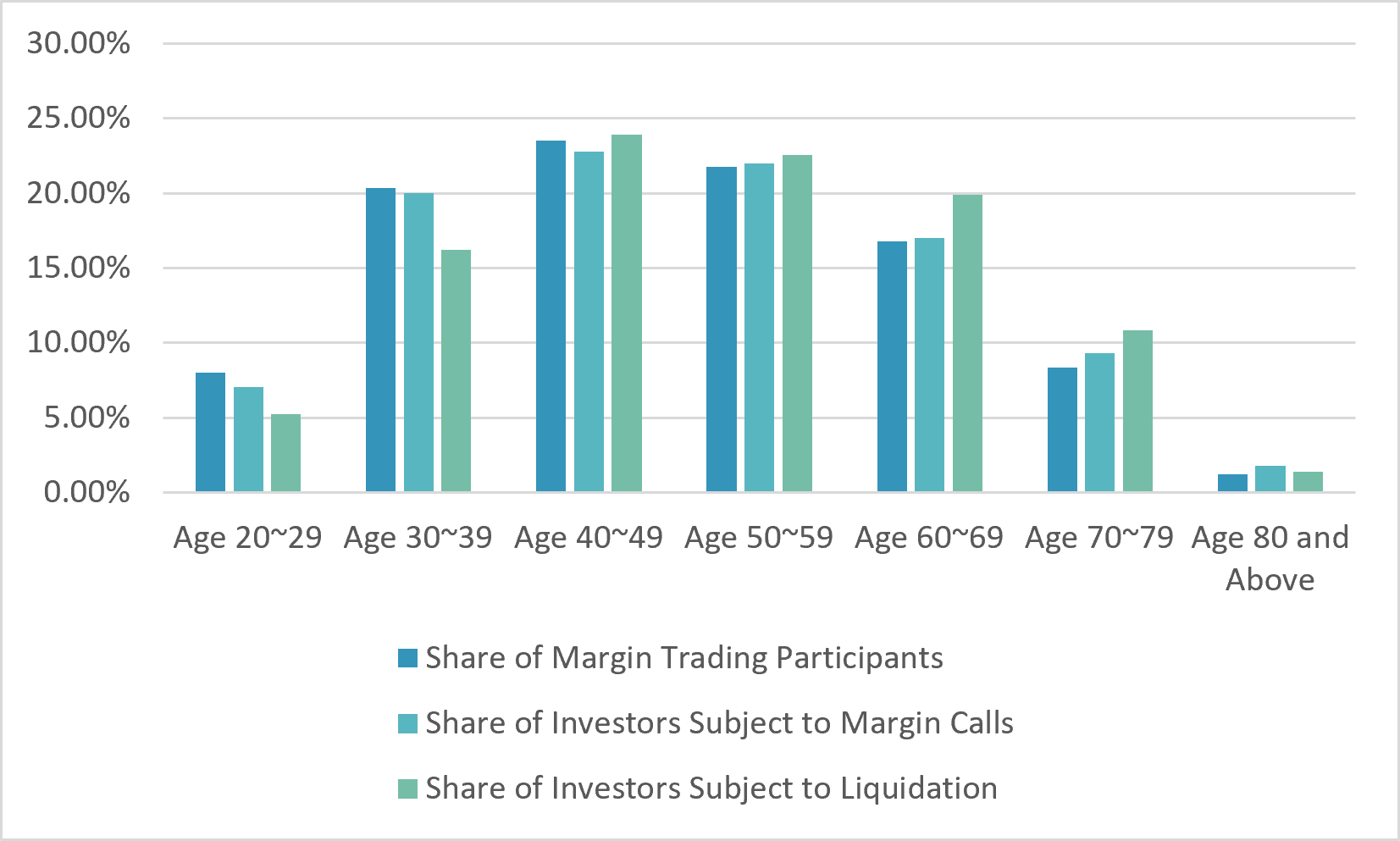
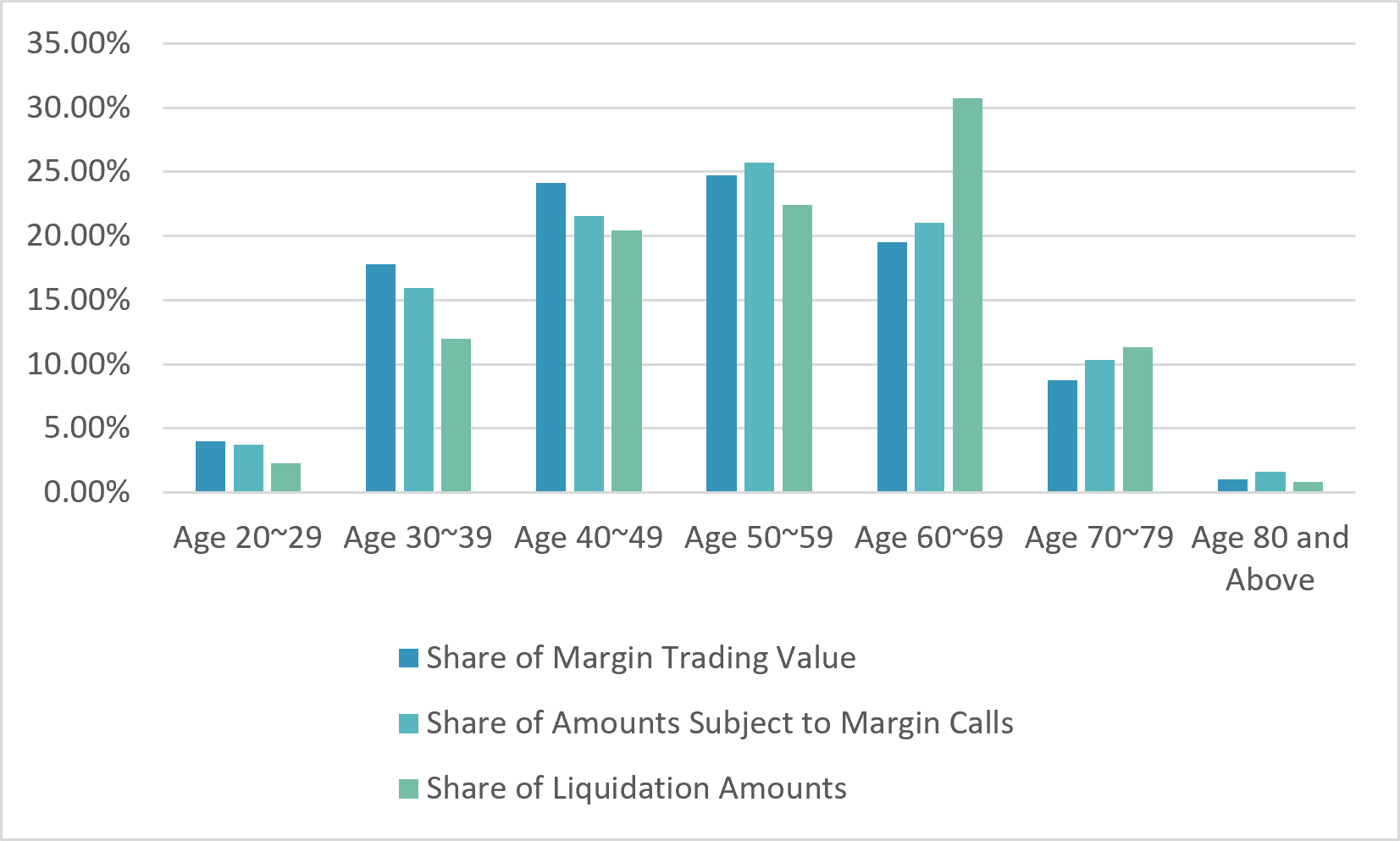
A further analysis of investors by age group shows that approximately 310,000 investors participated in margin trading from January through July 2026. Investors aged 30 to 69 accounted for 82.39% of margin trading participants and 86.18% of margin trading value. Notably, investors aged 40 to 59 consistently accounted for more than 45% of both figures, making them the principal participants in margin trading.
Investors aged 50 to 69 accounted for 38.55% of margin trading participants but 53.14% of liquidation amounts. In particular, investors aged 60 to 69 accounted for 30.74% of liquidation amounts, higher than their 19.50% share of total margin trading value.
By comparison, liquidation amounts for investors aged 20 to 29 accounted for only 2.28%, falling below their 8.02% share of participant numbers. This shows that the actual margin calls and liquidations are concentrated among individuals aged 50 to 69, suggesting that the younger demographic is not the primary source of risk.
Conclusion: Assessing the Real Impact of Margin Trading Requires Examining Relative Indicators and Market Structural Shifts
As trading value and the total market capitalization of listed companies in Taiwan steadily increase, the scale and depth of Taiwan’s capital market continue to expand. Against this backdrop of structural change, margin trading continues to serve the functions of providing market liquidity and financing, but its relative influence on the TWSE-listed market is no longer as significant as it once was.
When measuring market margin trading risks, a record-high margin loan balance merely reflects expansion alongside the broader market. Analysts should simultaneously observe relative indicators such as the share of margin trading turnover and the ratio of margin loan balances to market capitalization. Viewed through overall leverage, the ratio of margin loan balances to total market capitalization has remained persistently low, and the share of margin trading turnover in total market volume continues to shrink. Furthermore, as market participants trend toward institutionalization and diversification, the overall impact of margin trading on the market has become limited.
With respect to industry concentration, although margin loan balances are high in electronics-related industries, leverage ratios remain extremely low in relation to the substantial market capitalization and overall trading volume of those industries. Moreover, Taiwan’s industrial supply chain structure is robust, showing no imbalances from over-leveraging in specific sectors.
Reviewed from the angles of risk buffers and investor demographics, the market’s collateral maintenance ratio maintains an adequate buffer, and the scale of margin calls and liquidations poses minimal shock to market liquidity. Overall, current margin trading risks in the TWSE-listed market remain stable and manageable.