Company Profile
H2U Corporation (hereinafter “H2U”) was founded in 2013 as a digital health technology company. Leveraging artificial intelligence (AI) and health data to drive innovation across the healthcare industry, H2U has built a full-scenario health ecosystem spanning individuals, enterprises and healthcare institutions. Its core businesses include providing proprietary health information system applications and solutions, undertaking media advertising and sports event marketing, executing public-sector health promotion projects, and selling both its own and third-party health products. Guided by its mission to “extend humanity’s healthy lifespan,” H2U leverages digital technology to shift health management from treatment toward prevention.
Core Technology and Competitive Advantages
Key Core Technologies
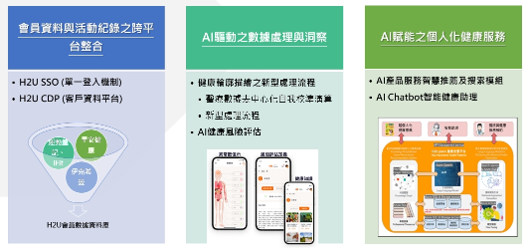
H2U has independently developed a single sign-on mechanism and customer data platform that integrates the members and databases of its various independent brands, binding and retaining member data across brands to build a health and behavioral data repository. H2U has also developed a proprietary “novel health profiling process” algorithm to calibrate health examination data from heterogeneous sources, and applies machine learning techniques to integrate health examination data and build “AI health risk assessment” models and algorithms for chronic diseases. Building on a knowledge graph core and combining large language models with retrieval-augmented generation and other technologies, H2U develops AI-enabled personalized health services.
Building a Closed-Loop Data Health Ecosystem
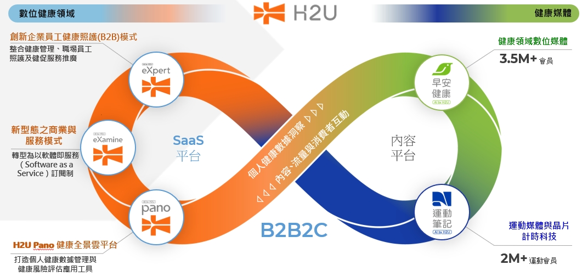
- Innovative Corporate Employee Health Management (B2B) Model: Integrating health management, workplace employee care, and health promotion outreach, H2U extends its services from corporate clients to employees and their families through an occupational physician and nurse information platform, connecting health examination institutions, health promotion service providers, and enterprises to form an ecosystem of services, data, and transactions.
- New Business and Service Model: The eXamine information platform has adopted cloud platform technology, transforming traditional system deployment services into a Software-as-a-Service (SaaS) subscription model and improving data management efficiency for health examination institutions.
- Building a Health Ecosystem with the “Panoramic Health Cloud Platform”: Using a cloud platform to integrate cross-industry collaboration programs across various health promotion services, H2U has built tools for personal health data management and health risk assessment, while simultaneously upgrading these tools for use by workplace-care employees and health examination participants, creating a B2B2C business and service model.
Operating Performance and Future Outlook
As a leading digital health brand, H2U is committed to driving innovation in the healthcare industry through artificial intelligence (AI) and personal health data, deploying AI computing power to build digital health infrastructure and creating a full-scenario health ecosystem spanning individuals, enterprises, and healthcare institutions. In recent years, H2U has earned international recognition, including being named among the Financial Times’ High-Growth Companies in the Asia-Pacific region and receiving the HR Asia award of Best Companies to Work for in Asia, and has secured support from Taiwan National Development Fund and multiple strategic investors. Looking ahead, H2U will continue to deepen its application of AI and health technology, expand the value of its health data platform, and work with industry partners to advance preventive medicine and smart health development, moving toward becoming an influential digital health technology platform in Asia.